A federal appeals court on Tuesday sided with Secretary of War Pete Hegseth, allowing the Trump administration’s exclusion of transgender-identifying individuals from military service to move forward. The 2-1 ruling from the US Court of Appeals for the DC Circuit overturned an earlier injunction issued by US District Court Judge Ana Reyes, a Biden appointee, who had blocked enforcement of President Donald Trump’s executive order barring persons “who express a false gender identity divergent from their sex” from serving.
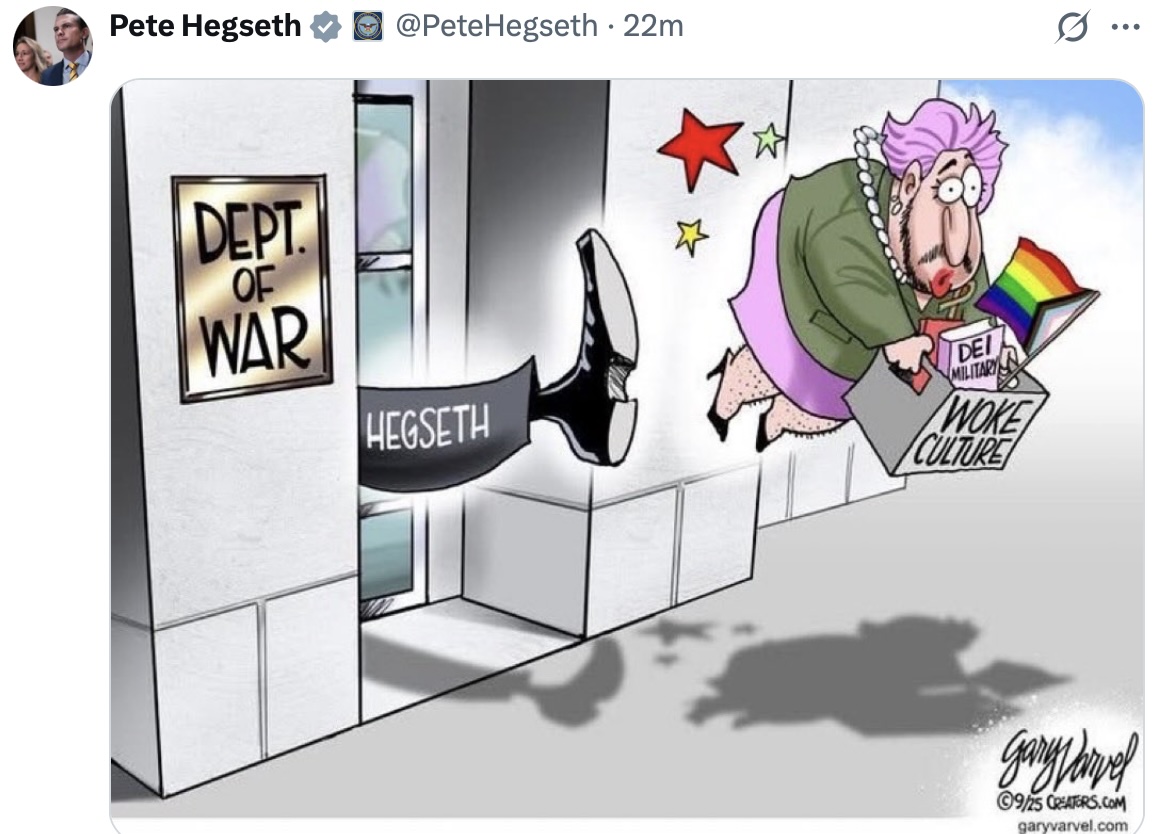
Almost immediately, Sec. Hegseth took to social media and posted a cartoon about it, shown above.
Judge Reyes’ injunction had temporarily halted implementation of the order, which the administration argues is necessary to restore longstanding military medical and readiness standards. The appeals court disagreed with her assessment, finding that the administration’s policy was “likely constitutional because it reflects a considered judgment of military leaders and furthers legitimate military interests.”
The executive order itself states that “a man’s assertion that he is a woman, and his requirement that others honor this falsehood, is not consistent with the humility and selflessness required of a service member,” language that signaled a return to earlier Pentagon policies that defined eligibility strictly by biological sex.
Judges Gregory G. Katsas and Neomi Rao, both appointed to the DC Circuit during the Trump administration, wrote that Hegseth’s position, that individuals diagnosed with gender dysphoria are not fit for military duty, was aligned with decades of military medical standards.
Before policy changes under the Obama and Biden administrations, gender dysphoria had been grounds for disqualification based on its documented impacts on mental stability, deployability, and the potential for ongoing medical treatment incompatible with global readiness requirements.
The majority opinion emphasized deference to military judgment, noting that courts have historically allowed the Department of Defense wide latitude to determine who is medically and psychologically fit for service. The judges also pointed out that the administration’s policy does not create a new category of exclusion but reinstates criteria that had been in place for many years before 2016.
The dissenting judge argued that the order raised constitutional concerns and that the plaintiffs could face irreparable harm if barred from serving, but the majority found that the government’s interests in readiness and unit cohesion outweighed those concerns at this early stage of litigation.
The ruling clears the way for the administration to begin enforcing the exclusion policy immediately, though further appeals are expected.