




By SUZANNE DOWNING
Alaska knew William Billy Mitchell before the rest of the country argued over him.
Long before courtrooms, headlines, and Hollywood, Mitchell was a young Army Signal Corps lieutenant helping stitch together a vast territory with telegraph wire.
From 1900 to 1904, he was a young man, all of 21 years old, working on the Washington–Alaska Military Cable and Telegraph System, pushing lines through wilderness, weather, and distance that humbled even seasoned soldiers. Alaska taught him what scale really meant, and just how unforgiving geography could be.
It was then that he predicted a future truth: “Whoever holds Alaska will hold the world.”
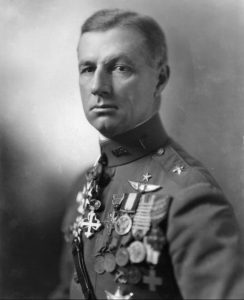
Mitchell’s time in Alaska shaped how he thought about the world long before airplanes could cross oceans with ease. He understood that Alaska was not a remote edge of the map but a central crossroads between continents, where distance collapses and geography dictates power.
Decades before radar stations, fighter interceptors, or global air routes existed, Mitchell warned that Alaska would be the hinge point between North America, Europe, and Asia.
His prediction proved true in World War II, throughout the Cold War, and remains true even today as Alaska continues to anchor America’s northern defense.
When World War I came, Mitchell was no longer stringing wire. He was commanding airpower on a scale the world had never seen. In September 1918, he planned and commanded nearly 1,500 Allied aircraft in the Battle of Saint-Mihiel, near Verdun, France, which was by far the largest air operation of the war. By the time the fighting ended, Mitchell commanded all American air combat units in France.
After the war, he was appointed assistant chief of the Army Air Service, where he became relentless, and increasingly unpopular for making the same argument over and over: Airpower would decide future wars. Armies that ignored it would pay dearly.
Mitchell argued that airplanes would fundamentally change naval warfare and could even render battleships obsolete. To prove it, he helped stage the 1921 bombing tests that sank a captured German battleship. The demonstration enraged parts of the military establishment. His own boss, Gen. John Pershing, and senior Navy leaders downplayed the results and dismissed their significance.
By 1925, Mitchell’s influence was waning inside the system. When his term as assistant air chief expired, he was not reappointed. Instead, he was reassigned as aviation officer for the Army’s Eighth Corps Area at Fort Sam Houston and was reverted to the rank of colonel. It was a demotion and a clear signal that his message was no longer welcome.
That same year, two Navy aviation disasters occurred. Navy Secretary Curtis Wilbur publicly suggested the accidents proved the limitations of airpower.
Mitchell was having none of it. On Sept. 5, 1925, he called a press conference and released a 5,000-word statement accusing the War and Navy Departments of “incompetency, criminal negligence, and almost treasonable administration of the national defense.”
That didn’t go over well. It was a line the Army could not ignore.
Mitchell was charged under the 96th Article of War and ordered back to Washington, DC. His court-martial began Oct. 29, 1925. The prosecution’s case was simple: it did not matter whether Mitchell was right, only that he had made unauthorized public statements. His defense intended to prove that he was right, calling dozens of witnesses and introducing thousands of documents showing that 163 recommendations he had made over seven years were largely ignored.
The courtroom became a referendum on the future of warfare.
Among those who testified for Mitchell were Eddie Rickenbacker, who had once served as his driver during the war, future Air Force leaders Hap Arnold and Carl Spaatz, and New York Congressman Fiorello La Guardia. Even Mitchell’s boyhood friend Douglas MacArthur (yes, that Douglas MacArthur) sat on the panel of generals judging him and is believed to have voted in his favor.
Public opinion largely sided with Mitchell. The jury did not.
One hundred years ago this week, and after just three hours of deliberation, Mitchell was found guilty on all specifications. The panel ruled that the truth of his statements was irrelevant. He was suspended from rank, command, and duty for five years without pay. President Calvin Coolidge signed off on the conviction, while commuting the sentence to half pay. Mitchell resigned from the Army on Feb. 1, 1926.
He never stopped speaking out, however.
Mitchell continued speaking out about how airpower would dominate future conflicts until his death in 1936. Eleven years after he passed, the United States Air Force did, indeed, become an independent service, a moment officially proclaimed “The Day Billy Mitchell Dreamed Of.”
In 1955, Gary Cooper portrayed him in The Court-Martial of Billy Mitchell. Two years later, an Air Force review board concluded that Mitchell had been tried for his views rather than for misconduct, effectively vindicating him.
Alaska, fittingly, remembers him with a mountain near Valdez: Mount Billy Mitchell. Historical markers along the Richardson Highway trace the telegraph lines he helped build, the literal connections that once held a territory together.
When I watch (in awe) as Air Force jets rise from Alaska’s military runways today, I think about that long arc of history: A young man stringing telegraph wire who forced the tough conversation that resulted in the creation of the US Air Force.
Alaska sits where continents meet, just as Mitchell said it would. And the men and women of the United States Air Force who are here live that reality every single day.
Billy Mitchell saw it first. And the Air Force proves him right every day.
Suzanne Downing is editor of The Alaska Story. Her grandfather served in Kodiak and the Aleutians during World War II.



5 thoughts on “Alaska saw Billy Mitchell first; he said ‘whoever holds Alaska will hold the world’”
Great topic Suzanne and nicely written.
Then. The Alaska Republican Party needs to get itself together and Fast!
2027 will decide where the Republican Party whether or not it limps along IF it wins the gubnatorial seat with a minority who’d force the majority to compromise with R’s if they want votes. Or if the Governor’s office goes Democrat and a Democrat Majoroty legislature, the Alaska Republican Party will become impotent; the Democrat party will finish the AkGoP off.
The aKGOP can’t afford to be wasting its time with 13 gubernatorial candidates all vying for the same donors
Excellent writing. It gave me goosebumps. When a warrior sees the future, people ought to heed the advice. Fear can be a powerful thing. More powerful than visionaries.
By extension, it is worth reflecting that if the extreme Left and globalist forces hold Alaska, THEY will hold the world.
Growing up in Alaska in the 60s I learned about the B-25 “Mitchel” light bombers used in the Doolittle raid on Japan. It was only last year, when visiting the Prince William Sound Museum in Whittier, that I learned that Jimmy Doolittle was from Nome ! How ’bout that 🙂