


By SUZANNE DOWNING
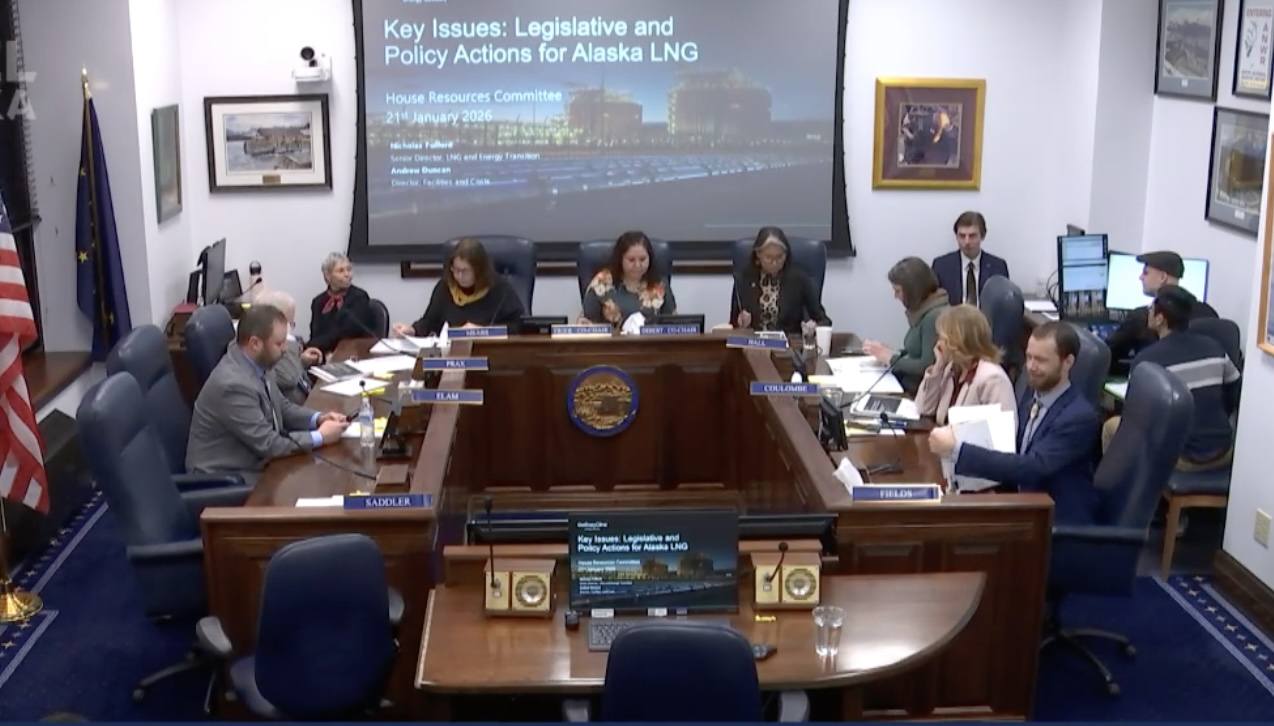
The proposed Alaska LNG project is a development of national and global significance, but one still marked by uncertainty, high financial risk, and major unresolved policy decisions. That’s what a presentation being presented to various legislative committees in Juneau says.
The report, commissioned by the Legislative Budget and Audit Committee, was designed to inform lawmakers about the potential legislative implications of the AK LNG project as it moves toward possible development.
At this stage, however, presenters from GafneyKline, an energy advisor company, emphasized that many of the project’s most important variables remain undefined, including capital cost estimates, gas supply arrangements, federal support, financing structures, and commercial agreements.
Because of those unknowns, the report concludes that it is not yet possible to outline specific legislative actions the Alaska Legislature may need to take, even as pressure builds to position the project for a final investment decision.
The central theme of the presentation was the balance every LNG-exporting jurisdiction must strike: enabling a project to reach a successful final investment decision while ensuring meaningful long-term benefits for the host state and its citizens. International experience shows that large-scale LNG developments almost always involve negotiated tax structures, regulatory stability, fiscal predictability, and some form of government participation or support.
Alaska, the report noted, will not be an exception. Given the massive upfront capital requirements and the need for stable long-term revenue streams, those policy decisions will be even more consequential than for most oil and gas developments in the state’s history, with the Trans-Alaska Pipeline System identified as the only comparable project in scale.
A major focus of the presentation was the project’s two-phase structure.
Phase I would consist of a gas pipeline supplying Southcentral Alaska and parts of the Interior, intended to address forecast energy shortages in the short to medium term. That phase alone would require a gas supply agreement with North Slope producers, regulatory approvals, long-term shipping contracts with utilities, a stable pipeline tariff structure, and a defined commercial and ownership model backed by financing arrangements. Presenters stressed that without these foundational elements in place, including updated cost estimates, investor confidence and project financing would not be viable.
Beyond in-state energy supply, the broader LNG export project would likely require both state and federal support mechanisms. The report highlighted growing federal interest in promoting U.S. energy exports as a tool of trade and foreign policy, noting that Alaska LNG has already attracted attention from energy-dependent Asian economies including Japan, South Korea, Taiwan, Vietnam, Thailand, and China. While governments may help facilitate the project, presenters emphasized that commercial contracts, not political agreements, will ultimately determine whether AK LNG moves forward.
Non-binding letters of intent and heads of agreement have already been signed with major buyers in Asia, representing a significant portion of the project’s proposed export capacity. Developers have stated that more than half of the planned 20 million tons per year capacity is subject to some form of preliminary commitment, though none of the agreements are binding.
GaffneyKline noted that while state-owned energy companies have shown interest, participation from private-sector buyers signals broader commercial appeal.
The report identified the project’s greatest obstacle as its capital cost and the risk of cost inflation. Current estimates remain at an early-stage, low-precision level, meaning actual costs could vary widely.
Despite the risks, the presentation outlined several competitive advantages for Alaska LNG, including shorter shipping distances to Asian markets, avoidance of global maritime chokepoints, access to large and well-characterized gas resources, and decades of prior permitting and project development work. Preliminary economic modeling suggests Alaska LNG could be competitive with Gulf Coast LNG, though that advantage could disappear if capital costs rise significantly or if project economics deteriorate during engineering and design.
The report concluded that while Alaska LNG holds strategic promise, the project remains in a pre-decision phase where major financial, regulatory, and policy questions are unresolved. Lawmakers were told that enabling legislation and a fiscal framework cannot be responsibly designed until a detailed economic model is completed and the scale of federal involvement becomes clearer. Until then, the state’s role will remain largely preparatory, focused on positioning Alaska to respond if and when the project reaches a stage where final investment decisions become realistic.
Alaska LNG: Long-dreamed-of project gained real traction in 2025



One thought on “AK LNG briefing by GafneyKline warns lawmakers of the big unknowns”
Don’t be surprised when it is announced the capital cost estimate is $65-$75Billion for this project.