


By SUZANNE DOWNING
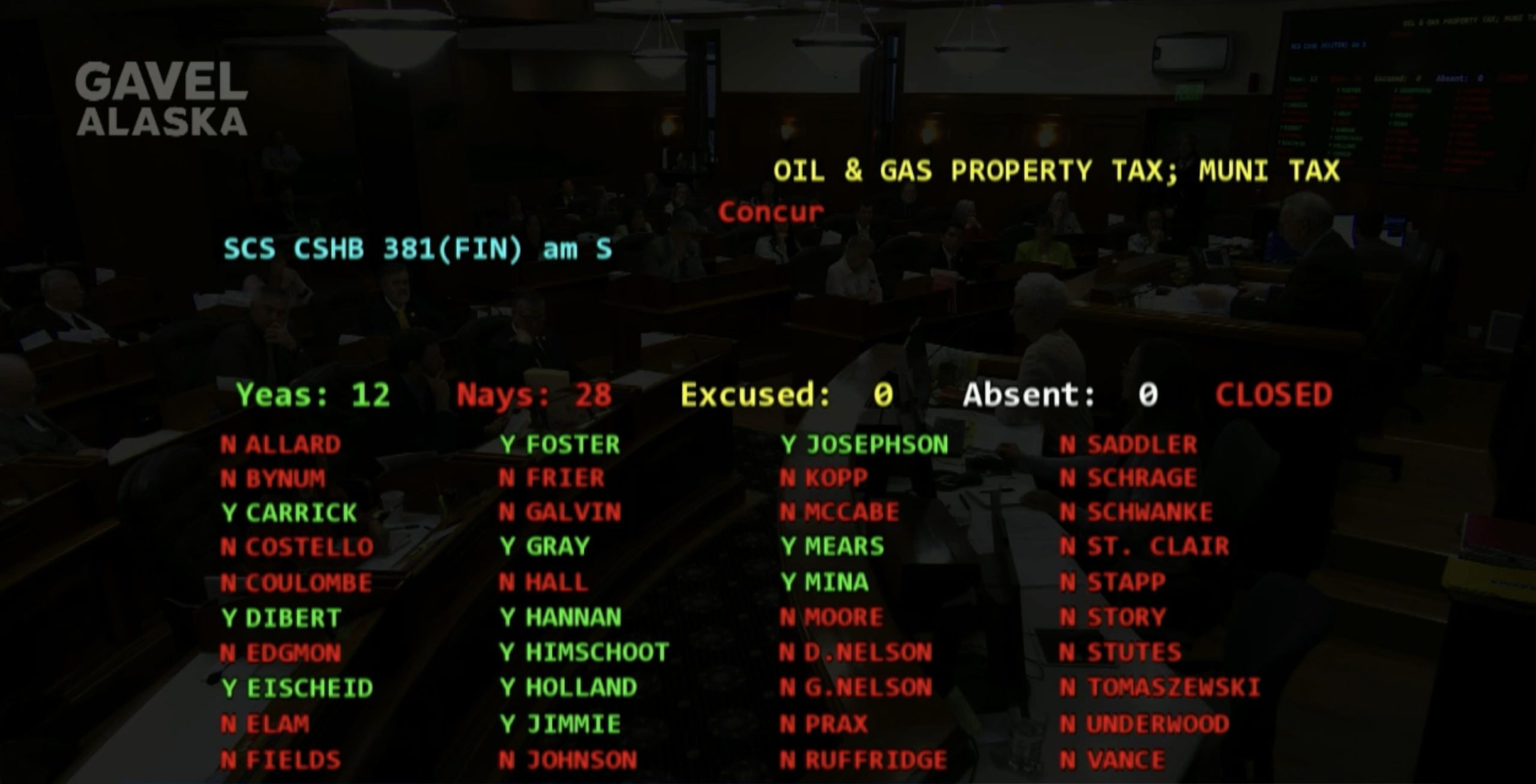
June 20, 2026 – The Alaska House on Saturday overwhelmingly rejected the Senate’s sweeping rewrite of House Bill 381, voting 28-12 against concurring with changes that conservatives said went far beyond the original purpose of the Alaska LNG tax package.
The vote came after the House adopted HCR 301, allowing lawmakers to act on HB 381, after the special session expired at midnight Friday, without having to start a bill over from scratch.
House Speaker Chuck Kopp spent several minutes outlining the extensive changes made by the Senate and explaining why House leaders were recommending a “no” vote on concurrence.
Among the Senate additions were major changes to public education funding, a significant reorganization of Alaska Gasline Development Corporation oversight and funding mechanisms, new reporting requirements, new confidentiality provisions, and creation of a public dashboard requiring AGDC to provide regular updates on project status.
The Senate version would also require annual reviews of AGDC finances and assets by Jan. 10 each year to determine whether the corporation is holding more money than needed. The legislation further tightens bonding authority by requiring legislative approval before AGDC can issue certain bonds.
A new heating fuel assistance fund was added for communities that would not have direct access to gas from the proposed pipeline.
Kopp noted that the Senate also changed the underlying tax structure. Rather than the House version, which focused on a volumetric tax framework, the Senate adopted a flat per-unit tax that increases over time, doubling during the first decade and doubling again by 2060. The Senate version also establishes specific revenue-sharing percentages for the North Slope Borough, the Kenai Peninsula Borough, and the State of Alaska.
The Senate inserted an additional deadline requiring the project to reach a Final Investment Decision by 2028 or lose access to the favorable volumetric tax structure. Lawmakers also added a municipal impact grant program and inflation-adjustment provisions.
Most controversially, senators inserted a new graduated income tax on S corporations and other pass-through entities. The tax rate climbs through multiple brackets and reaches 9.4 percent on taxable income above $5 billion.
The provision is counterproductive because it raises the cost of capital, undermines investor certainty, reduces competitiveness, and could complicate efforts to secure a final investment decision for the project.
Kopp also noted that several provisions involving foreign entities, inflation adjustments, taxation, and project oversight had never been vetted by the Senate or House before being attached to the bill.
“The House did not have an opportunity to thoroughly review many of these changes,” Kopp said as he urged members to reject concurrence and continue negotiations through a conference committee.
Most representatives agreed and the concurrence vote failed, 28-12.
Voting to concur with the Senate version were Reps. Nellie Jimmie, Rebecca Himschoot, Sara Hannan, Ted Eischeid, Ashley Carrick, Maxine Dibert, Robyn Frier, Andrew Gray, Ky Holland, Andi Story, Genevieve Mina, and Andy Josephson.
Following the failed concurrence vote, Speaker Bryce Edgmon appointed a three-member conference committee consisting of Reps. Calvin Schrage, Bryce Edgmon, and Justin Ruffridge.
The Senate is expected to appoint its own conferees for that committee.
Conference committees are used to negotiate differences between House and Senate versions of legislation and produce a final compromise package that must be approved again by both chambers.
Lawmakers then unanimously approved a resolution allowing the House to recess for more than three days without holding floor sessions. The House is scheduled to reconvene on Tuesday, June 30, at 10 am, although Kopp noted that members can be called back earlier if negotiations produce an agreement before then.
In the meantime, work on HB 381 will continue behind the scenes as House and Senate conferees attempt to bridge major differences over taxes, project financing, legislative oversight, and the future structure of the Alaska LNG Project.



4 thoughts on “House rejects Senate draconian changes to Alaska LNG bill, sends HB 381 to conference committee”
Costello discovered that she is a republican, after all
This one vote does not make her a rock star. Costello’s judgement is seriously flawed on most topics.
🤡🤡🤡🤡🤡🤡🤡🤡🤡🤡🤡🤡 in the House. Vote ’em out!
🤡🤡🤡🤡🤡🤡🤡🤡🤡🤡🤡🤡 in the Senate. Vote ’em out!
.
This batch doesn’t seem to realize that X% of ‘not very much’ equals ‘not very much.’ Even less, when it’s X% of Zero
Holland, Himschoot and Mears.. the same luddite trio standing in the way of home owners getting utilities that cross state park lands repaired and upgraded.