


By SUZANNE DOWNING
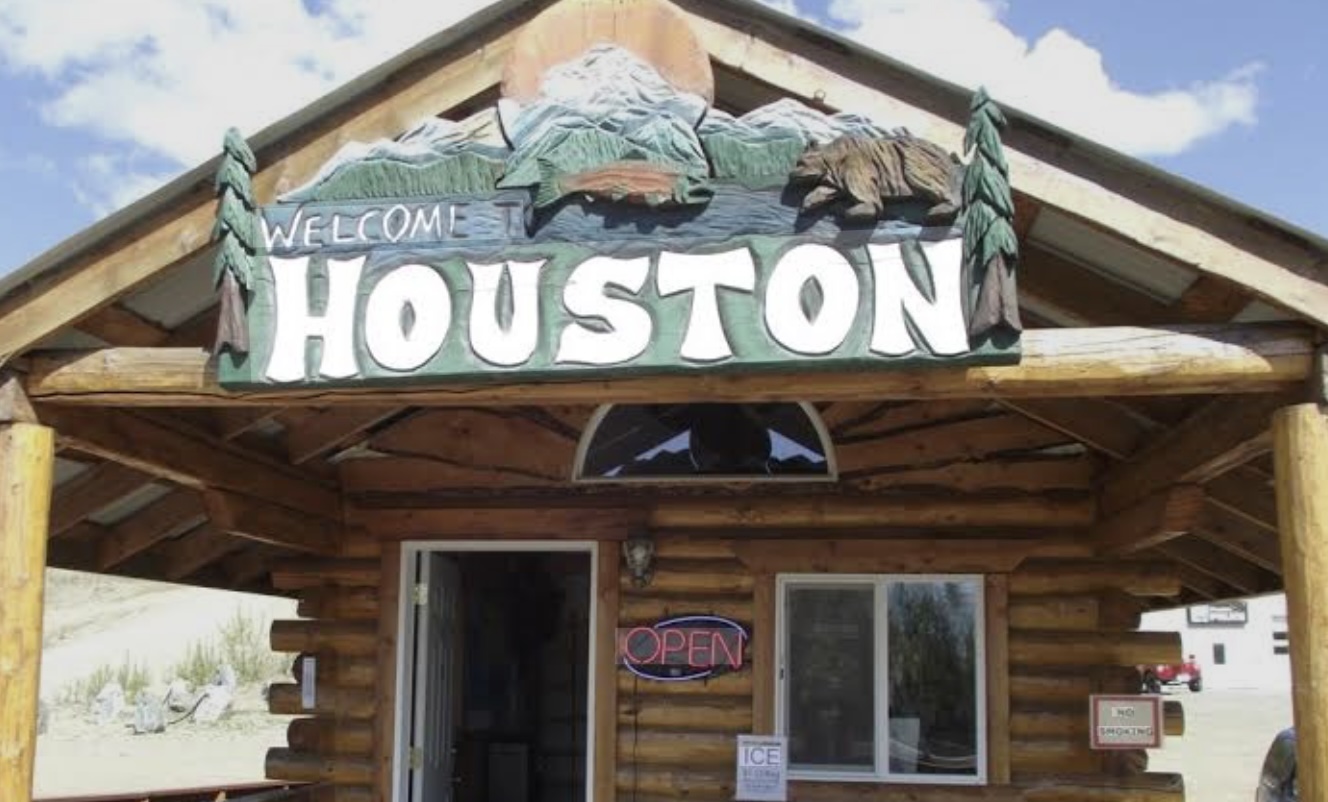
June 6, 2026 – Sixty years after it officially became a city, Houston celebrates its diamond anniversary on Saturday with a community birthday party, free ice cream, cake, local history displays, and a look back at how a small railroad siding (side track) grew into one of the Mat-Su Valley’s most distinctive communities.
Residents will gather at Houston City Hall for the city’s 60th anniversary celebration, which includes historic photographs, local treats, guest speakers, and an opportunity for residents to vote on a new anniversary logo commemorating the milestone.

The festivities reflect the community’s long-standing identity as “Where the Real Alaska Begins,” a slogan that captures Houston’s blend of rural character, independent spirit, and outdoor lifestyle.
Free ice cream from Little Miller’s begins at 2 p.m., followed by birthday cake and a lineup of guest speakers who have memories of the city’s past and hopes for its future.
Houston’s story stretches back more than a century.
The community began as a railroad siding associated with mining activity in the Susitna Valley. “Houston Siding” appeared on Alaska Railroad blueprint maps as early as 1917, the same year nearby Wasilla was established as a railroad town. The siding served mining operations throughout the region and later became an important logistics point during World War II, when the U.S. Navy utilized the rail connection.
As mining activity declined after the war, the area evolved into a homesteading community. Families began settling the surrounding lands during the 1950s as Alaska’s population expanded and transportation connections improved.
On June 6, 1966, local residents formally incorporated Houston as a third-class city, creating a municipal government and beginning the work of developing roads, services, and public facilities. Seven years later, in 1973, Houston was redesignated as a second-class city.
The city’s population rose from just 69 residents in 1970 to 370 in 1980. By 1990, Houston was home to nearly 700 people. The population exceeded 1,200 by 2000 and reached nearly 2,000 by the 2020 census, with recent estimates placing the community’s population above 2,100 residents.
Located along the George Parks Highway and the Little Susitna River, roughly 33 miles from downtown Anchorage, Houston has grown alongside the broader expansion of the Mat-Su Valley while maintaining a character distinct from its larger neighbors.
The city has become known statewide for two industries that have helped diversify its local economy.
Houston is one of the few communities in Southcentral Alaska where fireworks sales are permitted. Fireworks vendors along the Parks Highway generate significant sales tax revenue that helps support city services, including emergency response capabilities and fire protection.
More recently, Houston embraced another emerging industry after Alaska voters legalized recreational marijuana in 2014. Cannabis-related businesses and tax revenues have become a notable component of the city’s economic base, helping local officials broaden municipal revenue sources beyond traditional property taxes.
Yet for many residents, Houston’s appeal lies less in economics than in lifestyle.
The city serves as a gateway to outdoor recreation, offering easy access to fishing, hunting, hiking, snowmachining, and river floating on the Little Susitna. Veterans, retirees, families, and longtime Alaskans have all found a home in the community, drawn by its rural atmosphere and proximity to both wilderness and urban amenities.
Sixty years after incorporation, Houston remains one of Alaska’s most unique cities, where Alaska’s frontier spirit still feels close at hand, and where, as the city’s slogan proudly declares, the “real Alaska begins.”



3 thoughts on “Diamond anniversary: Houston, Alaska celebrates 60 years”
The City of Houston has 2100 residents. Chugiak-Eagle River has over 30,000. How come one is allowed to be a city and the other is not?
Wait, we’ve backed away from “Talkeetna has a cat as its mayor” and we’re talking about municipal matters in Mat-Su that are grounded in reality? The short answer to your question is the Local Boundary Commission. The background is more complicated. Around 1950, the feds changed the law. Communities were previously incorporated as towns. This changed to three classes of cities plus villages. The state constitution only allowed for cities, so villages were reincorporated as fourth-class cities after statehood. In the early years of statehood, it was trivially easy for subdivision developers and neighborhood associations to incorporate as cities. The only real political battle was for existing cities to maintain their position as boroughs emerged (the Alaska Municipal League was originally called the League of Alaska Cities, and their interests heavily favored city interests even as the concept of boroughs was written into the state constitution) , followed by the Mandatory Borough Act of 1963 championed by Rep. John Rader. Because of Article X, sections 12 and 14 of the state constitution, there existed the Local Affairs Agency in the Office of the Governor due to lack of a separate department at the time. Nothing of any real note happened there until Gov. Egan brought in Eben Hopson and Byron Mallott, who aggressively pushed for Bush communities to incorporate. Mallott’s work in particular soon led to a comprehensive overhaul of Alaska’s local government structure and the formation of the Department of Community and Regional Affairs in 1972. Eagle River’s push for self-determination began in earnest in 1965, but mostly in concert with the other unincorporated areas of the Greater Anchorage Area Borough in fighting aggressive annexation efforts by the City of Anchorage. The first major self-contained, self-determination effort occurred with borough incorporation in 1974, which was quickly annulled by the Supreme Court. The major difference is that standards existed by then which didn’t exist prior to 1972.
Houston where many Ukrainian refugees settled and rebuilt their lives; as well as demonstrating by example what being independent and sovereign looks like to government dependent Alaskans. They came here had to receive public assistance and found jobs and got the trade training education needed and no longer recieving state public assistance.