



By ALEXANDER DOLITSKY
June 5, 2026 – Indeed, religion shapes people’s values, behaviors, and morality by providing a framework of meaning, divine accountability, and community. While the exact degree of influence varies by individual, belief systems generally serve as a foundational guide for how individuals treat others and make ethical and just decisions.
French sociologist Émile Durkheim viewed religion as a fundamentally social phenomenon or institution rather than a divine one. In his foundational book, The Elementary Forms of Religious Life (1912), he argued that religious practices and beliefs serve to bind communities together, reinforce shared values, and promote social solidarity and collective conciseness; it is a soul of human society.
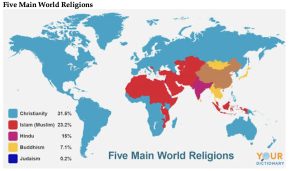
The major world religions are listed below chronologically, based on the emergence of their foundational texts, oral traditions, or historical founding dates. The exact dating of ancient religions—particularly Hinduism and Judaism—is debated by scholars because their initial tenets were passed down via oral traditions for centuries before being recorded in writing.
The spirit of Hinduism—Many paths to the one
Originating in the Indus Valley around 2300 BCE, Hinduism is recognized as the world’s oldest active major religion. Rooted in ancient chants inspired by the sages, it is the third-largest global faith with roughly 1.2 billion followers, making up 15% of the population, predominantly in India, Pakistan, and Sri Lanka. Roots of Hinduism date back roughly 4,000 years to the Indus Valley Civilization. It predates Buddhism, Christianity, Islam and, arguably, Judaism, growing from the spiritual chants and divine wisdom of early sages along India’s riverbanks. With over 1.2 billion adherents, it is the third-largest religion in the world. Followers view Hinduism not just as the oldest living faith, but as the foundational source of all world religions.
While Hinduism is conceptually simple—lacking a central authority or strict moral rulebook—it is practically vast. Across India, countless spiritual leaders spend hours daily debating its deep philosophical mysteries with their followers. Hinduism is often described as henotheistic or panentheistic. It embraces a singular, ultimate reality (Brahman) while simultaneously worshipping many distinct deities. Deities like Shiva, Vishnu, and Devi are viewed as different forms, manifestations, or aspects of that single, all-encompassing divine force.
Hindu philosophers long observed that while physical matter naturally decays, life itself constantly renews and transforms. They realized that every living soul is trapped in an eternal cycle of rebirth, shifting from plants to animals to humans in an endless loop. Ultimately, they concluded that this temporary physical world is merely a mask covering a single, permanent, and pure spiritual reality.
The sages reached an unavoidable conclusion: because the physical world is temporary, all worldly desires will ultimately end in frustration, which is the root of all human suffering. Therefore, true peace can only be achieved by controlling our desires and focusing our minds on the only eternal reality—God.
The ultimate objective of Hinduism is to achieve union with Brahman, the universal divine spirit. Brahman should not be confused with the Hindu god Brahma, or the priestly caste known as Brahmins. This spiritual oneness is achieved through ritual and ethical living, including nonviolence, charity, and deep compassion—values that were later widely adopted by Buddhism.
The law of Judaism—A living library (Torah & Talmud)
Originating around 2000 BCE, Judaism is the oldest Abrahamic religion, tracing its roots to the ancient Israelites and Abraham. Its essence is captured in the Shema—a foundational prayer recited daily by devout Jews: “Shema Yisrael Adonai Eloheinu Adonai Echod (Hear, O Israel, the Lord our God, the Lord is One).”
Spoken by Moses on behalf of God, these powerful words established a profound turning point in global religion by introducing the idea of strict monotheism. This concept of one true God forms the absolute foundation of Judaism, Christianity, and Islam, setting them apart from the polytheistic and philosophical traditions of the East and ancient Greece.
The Jewish concept of God centers on absolute uniqueness, expressed through the declaration, “I am that I am.” Every existing thing relies entirely on Him as the sole source of all goodness. While entirely spiritual and without a physical body, He is a personal deity who interacts dynamically with humanity through justice, anger, and love.
This framework establishes a theology of profound hope. Because God created the universe with a specific purpose, the physical world is real rather than an illusion, and time moves forward purposefully rather than in endless cycles. History is a deliberate upward climb toward the promise and ultimate challenge of the Kingdom of God. Consequently, human existence is not a burden to escape, but a divine gift meant to be lived to the fullest in alignment with His will. As the prophet Amos summarized this divine command: “Seek ye Me and life.”
Judaism is a deeply grounded, earth-centered faith. While it acknowledges an afterlife, its primary focus is guiding how we live in this world. Driven by a passionate commitment to human ethics, its goal is discovering God’s will through the Torah—the five books of Moses—which serves as the heart and foundation of all Jewish law and teaching; the Books of Moses set down the Ten Commandments. Although Judaism also relies on the other books of Hebrew Scriptures, Torah—the heart of the Jewish religion—stands for all Scriptures and for all the Law based on it.
Buddhism—A practical path to spiritual awakening
Buddhism is the world’s fourth-largest religion, boasting over 535 million followers, which makes up roughly 7% of the global population. Established in ancient India during the 6th century BCE by Siddhartha Gautama (the Buddha), this peaceable faith focuses on the pursuit of enlightenment and liberation from human suffering. From Sri Lanka to Japan, it remains a dominant and unifying tradition across much of Asia.
After observing its orange-robed monks and studying the vast archives of its calm monasteries, many Western scholars regard this philosophy as one of the greatest intellectual achievements in human history. Unlike many major religions, it outlines a moral framework rooted in reason rather than relying on the supernatural.
Buddhism is divided into two primary traditions: Theravada (historically termed Hinayana, or the “Lesser Vehicle”) and Mahayana (the “Greater Vehicle”). Each school features unique geographical concentrations and philosophical approaches to attaining enlightenment.
Theravada Buddhism is widely practiced in South and Southeast Asia, including Thailand, Laos, Cambodia, Shri Lanka, and Myanmar. Literally meaning “the teaching of the elders,” practitioners focus on individual salvation, monastic austerity, and achieving enlightenment (Nirvana) by emulating the personal example of the Buddha.
Mahayana Buddhism is predominant across East and Central Asia, including China, Japan, Korea, Vietnam, Tibet, and Mongolia. Known as the “Greater Vehicle,” it emphasizes universal salvation and compassion. Followers pursue liberation not just for themselves, but to help all beings achieve enlightenment through faith and good works.
Both spiritual traditions trace their roots back to Siddhartha Gautama (Buddha), a major historical religious figure born around 563 B.C. in what is now the Nepal-India border region. In the centuries that followed, the life of the Buddha provided a powerful and enduring model of enlightenment for countless followers.
Rather than rejecting his religious roots, Buddha built upon core Hindu ideas. He embraced the concept of reincarnation—an endless loop of living and dying—as well as karma, the moral law of cause and effect. He also maintained the belief that the material world is inherently full of ignorance and pain, and that the wise should strive to escape it.
The faith of Christianity
Emerging in the 1st-century A.D. (C.E.) Roman-ruled Judea, Christianity is rooted in the life and teachings of Jesus Christ. Unlike other faiths, it elevates all humans to beloved children of God rather than mere servants. This profound concept of divine fatherhood fueled its global spread and made the Lord’s Prayer the most widely recited prayer in history (Khan Academy Christianity in the Roman Empire).
At its core, Christianity opens its doors to anyone who accepts Jesus and strives to live by His example. This way of life connects people to a powerful divine faith and love that overshadows all other earthly concerns. Rooted deeply in historical events, Christianity uses the Cross—the symbol of Christ’s death—as its primary image. However, believers also hold that the resurrected Lord continuously acts as an advocate for humanity. Unlike other major world religions, Christianity uniquely emphasizes that its Savior is actively present in the everyday lives of believers right now.
Since its inception over two thousand years ago, the Christian faith has been grounded in two fundamental tenets: (1) the divinity of Jesus Christ as the Son of God, and (2) His incarnation to endure human suffering, die for the redemption of humanity, and achieve resurrection. This dual theological foundation serves as the primary distinction between Christianity and other global religions.
To stay vibrant, Christianity must actively engage with society. When a faith withdraws from public life, it risks irrelevance and isolation. By engaging with their communities, Christians live out their calling as “salt and light”, serving as an active force for compassion, love, justice, mercy, and positive change.
Islam—A secure citadel where submission is the absolute loyalty
Islam is the youngest of the major Abrahamic faiths, founded in the Arabian Peninsula by the Prophet Muhammad; it is defined by its pure monotheism. Centered on worshiping one Supreme God (Allah), it regards Muhammad (570-632 A.D.) as a mortal messenger rather than divine. Accounting for over 25% of the world population (World population 2026), it is a comprehensive way of life that closely unifies faith, daily affairs, and governance.
Emerging in the 7th-century Arabia, Islam expanded rapidly across the Middle East within a century. Its lasting unity comes from a simple, positive framework that has sustained Islamic unity for nearly 1,400 years. “Islam” means submission to God’s will, and “Muslim” denotes one who submits. Believers live in the continuous awareness of Allah, finding resilience, dignity, and global brotherhood (the Ummah) that transcends borders. Whether praying at home or on a Qibla mat, the connection to the Divine is continuous.
Islamic theology teaches that the revelations of Muhammad, recorded in the Koran, are the definitive, final will of God. While validating truths in Judaism and Christianity, Muslims believe the Koran supersedes and completes earlier scriptures. Islam honors figures like Abraham and Jesus but strictly rejects Christ’s divinity, maintaining that Muhammad is the greatest and final messenger, the Seal of the Prophets. Guided by the Five Pillars of Islamic Faith, believers shape their worldview through this ultimate submission to the omnipresent (ever-present) ruler, and omniscient (all-knowing) judge (Creator).
According to Islamic tradition, previous scriptures offered only an incomplete version of God’s message, which reached its absolute fulfillment in the Koran. While Islam honors earlier figures such as Abraham and Jesus, it maintains that Muhammad is the final and greatest messenger—the Seal of the Prophets. Furthermore, Islam denies Christ’s divinity and rejects any attempts to deify Muhammad, affirming that he was simply a mortal chosen to deliver God’s word.
The core connections
Religion instills core principles such as benevolence, tradition, conformity, and security. It defines what a community considers sacred, just, or important. Faith often frames moral duties as divine laws or universal truths. It sets the boundaries between right and wrong, good and evil, often personified through religious figures or texts.
Indeed, religion dictates actionable behaviors, such as daily rituals, dietary restrictions, and community service. It acts as a “moral GPS” (moral compass), often providing consistent decision-making guidelines across different contexts, as it is evident from five major world’s religions briefly described above.
The author was born and raised in the former Soviet Union before settling in the U.S. in 1978. He moved to Juneau in 1986 where he taught Russian studies and Archaeology at the University of Alaska Southeast, and Social Studies Teacher at the Alyeska Central School of the Alaska Department of Education. From 1990 to 2022, he served as a director and president of the Alaska-Siberia Research Center, publishing in the fields of anthropology, history, archaeology and ethnography. Find him on Amazon.com.



16 thoughts on “Alexander Dolitsky: Core values of five major world religions”
I’d really be interested in an honest conversation about how the values of major religions impose their beliefs upon others. Based upon the list above the level of historic severity would likely be in similar order, with 1-3 being a toss up.
Good observation, Steve. Read my article between the lines, applying “Aesopian language/method” that conveys hidden meanings. This technique focuses on revealing deeper, indirect messages rather than direct interpretation.
”Religion was invented by man to stave off the fear of death”
People that over indulge in their faith wrongfully push that religion on to others, not to save souls, it’s because the pusher feels less insecure.
Most all major wars are started because of religion.
Anthropologists suggest that religion, likely, originated as a survival tool and a way to explain an unpredictable world and surrounding natural phenomenon. Early humans used spiritual concepts to understand nature before the rise of science, while shared beliefs and rituals ultimately united groups, enforced social morals, and offered comfort when facing the unknown and mortality.
Historically, there were many religious wars; nevertheless, Napoleonic wars, Roman Empire and Mongol expansion, WWI and WWII were not religious wars.
The Jews in Germany just prior to WW2 were annoying the general German populations who accused Jews of catering to Jewish businesses and social gatherings, keeping to themselves and were not feeling the pinch of a bad economy as much as the German general population which triggered resentment and ultimately a war on the Jews which spread to other flashpoints including territory, so yes, WW2 started because of religion. The Iran Israel war at present is also a religious war (which I’m in favor of U.S. intervention), the U.S. civil war where the Northern Liberals defeated the Southern religious conservatives and on and on and on.
Nations also hid the presumption of religion as a war excuse.
Let’s not forget the crusades which were actually wars by correct definition.
I believe in the scientific theory of life after death because of the evidence of ”time and space have no beginning and no end” which we are all a part of., now someone may say that’s a religion?
Keep it going Alexander.
Not a single nation went to war because Hitler was killing Jews, none. WWII was not a religious war.
The Civil War in the US was most certainly not a religious war. A war over disagreements about states right and how they pertain to slavery is not a religious war.
The terroristic Iranian regime is religious and since they’ve been abundantly clear about their intentions to start a holy war to bring about the return of the 12th Imam who has been in hiding since the 9th century and according to them will bring about an apocalyptic battle before taking over the world in a Muslim caliphate.
Germany blamed Jews for Germanys loss of WW1 and Germany blamed Jews for their centuries old religious anti infidel exclusiveness which Hitler also used as an excuse to hunt down Jews in Germany, Poland , Austria and other countries in Europe and soon become a political and territorial dispute. but it started with religion, religion and religion. Is Jew a nationality or religion?
I don’t give a rip what you or anybody else thinks.
By the way, did you ever hear of the crusades, the war chant of the Japanese kamikazes, The War in Iraq, the last words of the 9-11 terrorists yell out, allah is great. It’s all religion.
But if our nation is attacked, I’ll line up with the Christians any day of the week to save our nation.
I’m offering an education here, be grateful.
The confederate south used the Bible to justify slavery, the civil war was about states rights and slavery.
Religious.
Your claim seems to be that because someone somewhere ready a religious book and a war happened that all wars are caused by religion. There are religious wars and they are as bad as the wars for other causes, but you have yet to make a compelling case that WWII or the US Civil War were religious wars.
Throughout human history, numerous conflicts have been driven by faith; nevertheless, major historical events like the Napoleonic Wars, the expansions of the Roman Empire and the Mongol Empire, as well as the First and Second World Wars, were driven by political, territorial, and economic goals rather than religion.
Your point depends upon the entire cosmos having popped into existence, by itself, from nothing, in the void of space. That includes all matter, energy, life, and time itself. Furthermore, it all happened in strict accordance with a myriad of immutable laws of physics (nature). Logically, the only possible explanation for the existence of such a system would be a creator existing in a completely different realm unbound by the confining laws of the creation. Such a creator would not even be bound by the law of time itself. The only one fitting this description is described in the book of Genesis. His name is YHWH, We did not invent Him–He reveals Himself to those seeking Him. To meet Him, read the book. “Respect for YHWH is the beginning of wisdom.” Prov 9:10
Wayne, as you know, the creation of the universe is a cosmological event regarding the origin of physical reality, whereas the existence of an ever-present God is a theological and philosophical concept of a supreme, timeless being. In contrast, the creation of religion is a historical and sociological development–a set of human institutions, rituals, and dogmas built to interpret the divine and structure human society.
Professor Dolitsky, you seem to bifurcate our perceptions into the observable and the spiritual. In reality, those two realms are not separate. He has given us the ability to reason, with which we realize nothing in the physical cosmos can spring into existence by itself. And, life itself only springs from life. Every one of the infinite particles of creation are an individual testament to the existence of a creator. By all accounts, YHWH spoke to Abraham, Isaac, Jacob, Moses, Elijah, and many others. He chose to communicate to the world through the Israelites. He created us, He loves us, He wants us to pursue Him. All truth we have is revealed to us by Him.
Wayne, I deeply value your scholarly grasp of biblical texts and your sophisticated theological comprehension of creation.
Absolute nothing? , Nothing has a plus or minus pressure and Temperature (-400 below ) or so and that little something is actually a big something. Time and space have no beginning and no end. This is not our first life or our last.
Keep it going Wayne.
God is a he (male)? Not a she (female)?