


By SUZANNE DOWNING
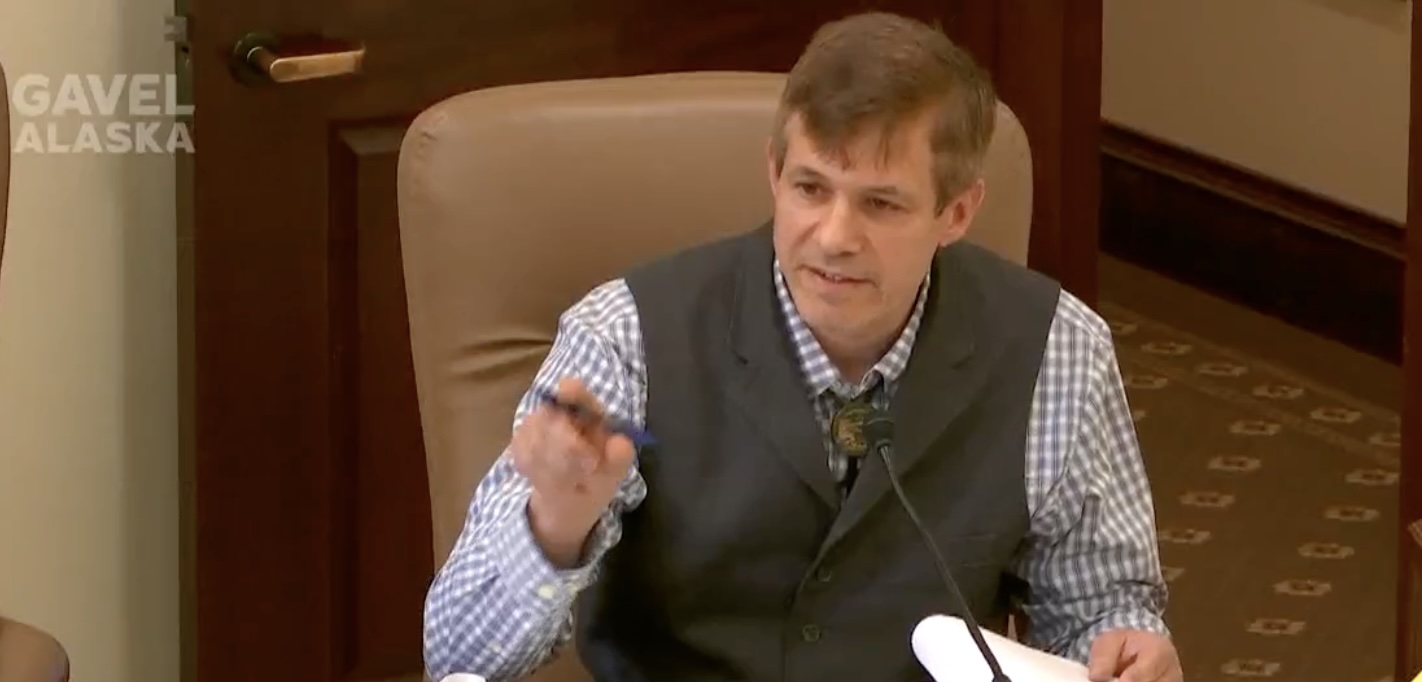
June 4, 2026 – As Alaska lawmakers continue debating legislation tied to the proposed Alaska LNG project, Sen. Bill Wielechowski has emerged as one of the most vocal critics of the tax provisions sought by project developer Glenfarne and supported by Gov. Mike Dunleavy.
In a lengthy social media post, the Anchorage Democrat argued that the Alaska natural gas pipeline can already be built under existing law and does not require legislative action. He pointed to existing federal permits, financing mechanisms, and prior testimony from Alaska Gasline Development Corporation officials who indicated the project was economically viable under current statutes.
“The reality is that no legislation is needed to build the Alaska Natural Gas Pipeline,” Wielechowski wrote. “They can build it right now.”
Wielechowski characterized the special session as another example of outside developers seeking major tax concessions from Alaska in exchange for promises of future economic development.
Drawing parallels to past controversies involving the Alaska Gasline Inducement Act, the Amerada Hess royalty litigation, and the passage of SB 21 in 2013, Wielechowski argued that Alaska has repeatedly been asked to provide incentives based on promises that later failed to materialize.
He also criticized Glenfarne’s requests for changes to Alaska’s property tax structure and corporate tax treatment, arguing the proposals could deprive the state and local governments of billions of dollars over the life of the project.
But the debate centers on a fundamental question: whether Alaska should collect a smaller share of revenue from a gasline that gets built or continue collecting nothing from a project that never advances. Zero percent of zero is still zero.
While permits and federal approvals are indeed in place, financing a project estimated to cost at least $44 billion remains the central challenge.
Alaska’s current oil and gas property tax structure imposes unusually high costs on large infrastructure projects during construction and early operations, creating hurdles for lenders and investors evaluating whether the project can compete against LNG projects elsewhere in the world. It’s not done like this in other oil-rich regions.
Gov. Mike Dunleavy’s proposal would replace much of the traditional property tax burden with a volume-based tax tied to actual gas throughput, aligning tax collections with revenue generation rather than assessed asset values that take years to build. Supporters contend the proposed changes are not a tax elimination but a restructuring designed to improve the project’s ability to attract financing.
Supporters of the gasline legislation also reject Wielechowski’s characterization of Senate Bill 21 as a failed policy. They point to Alaska’s experience under the previous ACES tax regime as a cautionary tale about what happens when the state pushes taxes beyond what investors consider competitive.
By the early 2010s, throughput in the Trans Alaska Pipeline System had fallen dramatically from its peak of more than 2 million barrels per day. Concerns about declining production became so severe under the ACES tax frame that the federal Energy Information Administration warned in 2012 that continued declines could eventually threaten the operational viability of TAPS by the year 2026. This year. The ACES tax structure discouraged investment in new fields and sent capital to competing oil provinces around the world.
SB 21 helped reverse that trajectory by encouraging new investment and attracting new entrants to Alaska. Projects such as Pikka, which is expected to add significant new production to the pipeline and generate royalties, production taxes, property taxes, corporate taxes, and Permanent Fund deposits for decades to come, would not have been build under ACES. Many of the newer developments also carry royalty rates that return a substantial share of over 16% of production value directly to the state.
To gasline historians, the lesson from the ACES-versus-SB 21 debate is directly applicable to today’s pipeline discussion. Alaska must decide whether it wants to maximize taxes on paper or maximize the likelihood that a project actually gets built. A tax structure that prevents investment ultimately produces nothing: No jobs, no gas, no royalties, and no revenue.
That argument is at the heart of the current choice facing lawmakers — a gasline with tax adjustments or no gasline at all.
There is irony in the debate: Glenfarne ultimately needs North Slope producers and investors to commit billions of dollars to the project. Those same companies are being asked to shoulder higher tax burdens at the very moment Alaska is seeking their participation. In an increasingly competitive global LNG market,Alaska cannot simultaneously court investment and make itself less attractive than competing jurisdictions.
Wielechowski also raised concerns about projected consumer gas prices, citing estimates presented during legislative hearings that suggested delivered gas costs could exceed current prices during the project’s initial phase.
He criticized what he described as Glenfarne’s efforts to remove legislative provisions that would have protected consumers from cost overruns and capped future gas prices. He also questioned why the company objected to proposals that would have required it to pay corporate income taxes or accept limits on passing construction costs on to consumers.
However, the price estimates cited during legislative hearings depend heavily on assumptions about financing costs, construction expenses, and market conditions years into the future. Without the gasline, Southcentral Alaska could face an even less desirable future marked by imported LNG, supply shortages, and higher energy costs.
Also, a lower tax burden directly reduces transportation tariffs and therefore improves the economics of delivering gas to Alaska consumers. Rigid statutory price caps or guarantees may sound attractive politically but could make financing impossible by shifting excessive risk onto investors.
Wielechowski’s broader argument is that lawmakers have a responsibility to protect Alaska’s treasury, schools, infrastructure, and Permanent Fund Dividend from what he sees as another costly giveaway.
But fiduciary responsibility includes evaluating the cost of doing nothing. Failure to commercialize North Slope gas would leave trillions of cubic feet of stranded resources in the ground while Alaska faces declining Cook Inlet supplies and rising energy uncertainty.
With lawmakers continuing negotiations during the special session, the outcome may determine whether Alaska finally commercializes its vast North Slope gas reserves, or if this is another chapter to the state’s long history of gasline proposals that never reach construction.

20 thoughts on “Sen. Wielechowski argues for the ‘no gasline’ option”
How does he heat his house and drive his cars?
the legislators who been around since Walker they are holding out for China to build the gas pipeline. China is in their pocketbook.
Remember Sen Wielechowski never fought against Fmr Governor Bill Walker’s gas pipeline deal with China.
Today he is strongly against this building of a gas pipeline, and China won’t profit off of it. Tells Alaskans everything they need to know about the Traitor Sen Wielechowski. Who’s more important. Alaskans!? Or China.
Bill Walker’s wife returned from China with loads of cash while on a travel junket when he was governor. What was that money for? Did Bill’s Chinese lords pay off the Walkers like they paid off Hunter Biden and the Big Guy?
Do not, repeat…Do Not, trust Bill Walker.
The Walker Gasline deal with the Chinese had a buyout clause so eventually Alaska would be 100% owner with natural gas galore to boot.
The funny thing about the Belt and Road Initiative is that all of the eventual buyout clauses are virtually unattainable, only third world countries with no options or complete idiots would ever sign up for the exploitation offered by the CCP. It’s not surprising that the failed former governor bent the knee to the Commies. I’d like to think this doesn’t explain your world view, but the evidence is mounting.
Oh stop it!
Though I think Dunleavy fumbled the football at his own 5 yard line, there cannot be a Gasline without a phase 2 supported by the big dog oil companies which would be necessary to export LNG.
Dunleavy would have had to rely on delisted middleman Glenfarne to find a builder that very well may employ Chinese Commies and a million illegal aliens, who knows with Glenfarne who would have owned 75% of the line.
Summarize; North Slope oil companies will not commit to releasing vast quantities of LNG for phase 2 pipeline and jeopardize oil field well pressure maintained by the use of re-injected natural gas.
Oil companies are interested in oil production, not LNG production.
I’d like to see anything that suggests this statement might be a possibility “a builder that very well may employ Chinese Commies and a million illegal aliens” sure seems like yet another logical fallacy on your part since there is absolutely nothing to suggest your apparently desired outcome of doing such.
Isn’t Bill Wielechowski a lawyer for the IBEW 1547, doesn’t he want jobs for his fellow union members?
I am not sure that they want jobs requiring actual work at all; they would probably be happy with suitcases of money.
If the existing tax regime was so sweet for Glenfarne why wouldn’t an energy firm with a lower cost of capital jump in?
Of course he does , hes one of the BANANA caucus ( Build Absolutely Nothing Anywhere Near Any thing). Meaning he opposes any form of energy not derived from people in hamster wheels no fossil fuels no hydro, no nothing that might make lives better than mud huts, igloos or caves
Of course he does , hes one of the BANANA caucus ( Build Absolutely Nothing Anywhere Near Any thing). Meaning he opposes any form of energy not derived from people in hamster wheels.no fossil fuels no hydro, no nothing that might make lives better than mud huts, igloos or caves
Protect the PFD? The one that the ENTIRE LEGISLATURE continues to steal from, year after year? The constitutionally protected PFD, I might add.
Senator Wielechowski, if no legislation is needed, will you show Alaskans the binding financing, binding FID path, binding gas supply agreements, and binding customer contracts proving this project can be built under current law? Yes, you might be right….who’s money will build it, Bill?
Neither the Legislature or any living (or dead) person has the ability to “decide” or “cap” the price of any commodity and particularly natural gas. Markets determine prices. Economist Friedrich Hayek correctly asserts that human beings are unable to design and control complex societies. Hayek calls this notion “the fatal conceit”. Extensive price controls were attempted in the former Union of Soviet Socialist Republics (USSR). It did not turn out well.
The two quotes in the senator’s post appear to come from two different AGDC officials.
1. “I believe that if the Legislature gets involved, that this project will go away.”
This was said by Mike Chenault during legislative testimony in April 2025 while serving on the AGDC board.
The fuller quote reported by multiple outlets was:
“I believe that if the Legislature gets involved, that this project will go away. I believe that if we start changing the terms of the statutes, then that creates indecision and that will cause the project to possibly go away.”
Chenault was arguing that the Legislature should not alter the statutory framework governing the project because investor uncertainty could jeopardize financing and development.
⸻
2. “There’s no consideration for property taxes. The existing statutes are what are in place and will be abided by.”
This quote was attributed to Frank Richards, AGDC’s president.
The most complete version I could locate states:
“There’s no consideration for property taxes. The existing statutes are what are in place and will be abided by.”
According to reporting summarizing 2025 legislative testimony, Richards made the statement while discussing Glenfarne’s agreement with AGDC and whether special property-tax treatment was contemplated. The reporting says he indicated the project would proceed under existing law and did not suggest that a property-tax overhaul was necessary.
⸻
What makes these quotes politically significant?
The current dispute stems from the contrast between:
* AGDC and project supporters in 2025 emphasizing that the project could move forward under existing statutes and warning legislators not to interfere.
* The 2026 push by Glenfarne Group and the Alaska Gasline Development Corporation-backed proposal for major changes to the project’s tax structure, particularly regarding property taxes.
Supporters of the tax legislation argue that updated financing realities and investor requirements justify the changes. Opponents point to the earlier testimony and ask why a project previously described as economically viable under existing law now requires substantial tax modifications.
Yes, I remember TransCanada and the contract for $750 mil contract with a$500 mil start. But, they had to go through a competitive bid process which HAS NOT happened with Glenfarne because the Crime Boss Dunleavy governor has not followed the legal process for obtaining a contract. It was a beginning and two big oil companies were on standby to take up the business at the time, Exxon and Conoco Phillips. There were other bids but to small to consider.
The difference with all of that and what is happening from governor’s office is a company wanting access to bigger bucks than Palin put out. Glenfarne has had no competitive bid process giving the state strong terms to put them out if they don’t follow the contract on competitive process. Palin’s handling of this part of competitive business is not the case of Dunleavy’s Alaska LNG, its a case of passing unsecured money to a business, Glenfarne that works primarily with third world countries and because Dunleavy does everything in a half-assed manner and that he intends to find another place for himself after his time is up.
There is no survey on that line marketed to the public and never has been. Go to FERC.gov and look up the information as to what they say under oath to the legislature. NO certificate has been given to Glenfarne for this project, ever. Also, when you look in the FERC site look for the approval for shipping. There is none. The big deal is free money in a big way and that was improvised by Dept Interior Bergham. There has never been a comment period because there is no contract. GLENFARNE wants FREE money from the PFD. The issue of TAXES is a put on and I encourage everyone to call and send emails to the legislature to stop the crape on taxes and kill the bill, SB 2001. The whole endeavor is a SHAM and s bogus marketing scheme on Dunleavy’s part to remove more PFD money for the SHAM.
The two surveys for a gas line were completed by the end of the survey contracted by Governor Palin to the Yukon border. The two contracted surveys ran parallel to the oil pipeline. If built on the surveyed track, there would be no destruction of environment and the permit period would not be a problem because all of that ground where the pipe is today was permitted and anything else requiring permits would be waived. Also no studies would need to be done to determine feasibility studies. They were done and the oil pipe was built. No need for environmental law suits.
The only issues to put through the works is a comment period for people who live along that pipe corridor, concern of animals and people with needs and construction concerns.
The liquification process plants should be constructed probably in Delta Junction or Glennallen due to the best ground soils for those types of industries needing that advantage. The whole line already has legal, navigational, safety planned navigational and shipping lines out of Valdez under Maritime law and US Congressional National Security approval. Yes, jobs are needed but just as with the oil pipeline, this gas line through the same area will produce work, living and jobs.
Shipping out of Valdez is the safest, with national security approved by congress, and best and a done item in the FERC.gov process.
Its up to the people of Alaska to take their lives in hand and make the change instead of letting the idiots of Glenfarne thinking take over and steal the future of the residents of this state. Alaskans are not going to tolerate extortion by any company, persons or country.
Actually if the Chinese did build it back during Walker days, it wouild have been cheaper before Covid. I don’t understand why people were so against that if the State got their Royalty check. Who cares who buys the gas as long as the State got it’s cut.
If there was a buyout clause and it was negoiated correctly, the State might have come out ahead but that might be too wishful thinking unless the State hired a really good advisor and law firm
Let’s step back for a broader view. Petroleum is a competitive world-wide market in which the price is set by the fundamental law of supply and demand. Oil and gas that is easiest to bring to market will always have an economic advantage over that which is more remote or difficult to bring to market. In this respect, the Middle East and other sources have an obvious advantage over Alaska. We cannot expect the same return as these locations. We can only compete by accepting a lower return on equity (taxes and royalties). However, even when we accept less, we will still be greatly enriched. Energy is the lifeblood of the world economy. I suggest Sen Wielechowski adjust his position to acknowledge economic reality.