


By SUZANNE DOWNING
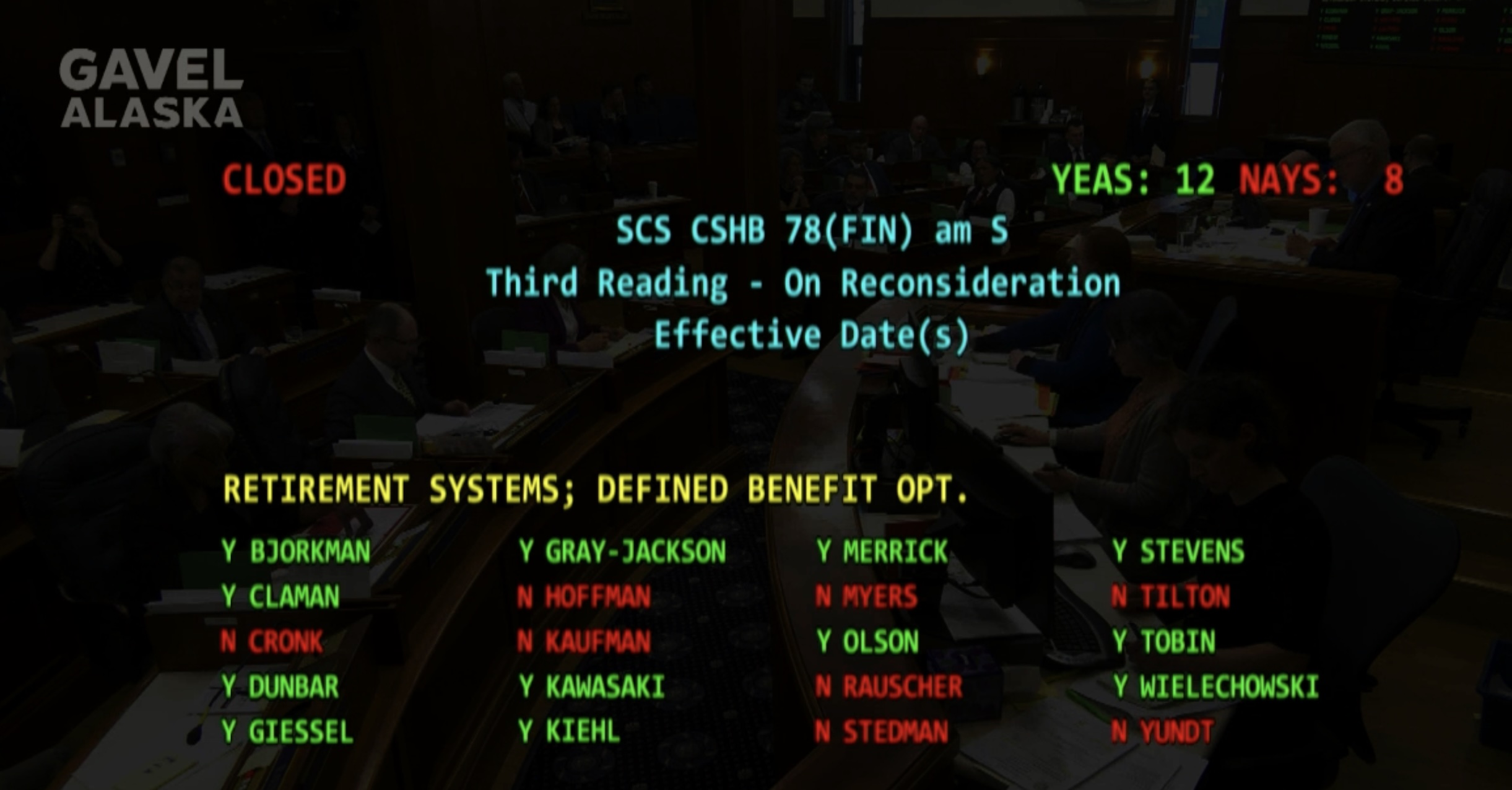
April 28, 2026 – The Alaska State Senate on Tuesday approved House Bill 78, advancing a measure that would reinstate defined benefit (pensions) for public employees and setting up a high-stakes decision for Gov. Mike Dunleavy.
The bill passed on a 12–8 vote, largely along caucus lines, with the Democrat-led majority supporting the return to a pension system that Alaska abandoned two decades ago because it was bankrupting the state. The Senate Republican minority caucus quickly responded, urging the governor to veto the legislation, warning it could expose the state to billions of dollars in long-term liabilities.
“The Senate Republican Caucus has the deepest respect for our public employees. However, we cannot support a policy with unknowable future costs, obscure fiscal notes, and a legacy of failure,” the caucus said in a statement following the vote.
Alaska moved away from defined benefit pensions in 2006, transitioning new hires into a defined contribution system similar to a 401(k), after rising costs strained state finances. Despite that shift, the legacy system continues to weigh heavily on the state’s books. Lawmakers point to roughly $7.5 billion in unfunded liabilities that remain, requiring annual payments of about $200 million to keep the system solvent.
Democrats and some Republicans, like Sen. Cathy Giessel, Sen. Jesse Bjorkman, and Sen. Kelly Merric, argue that reinstating pensions will help the state recruit and retain workers in critical fields, such as public safety and education. But opponents say there is little clear evidence that a return to pensions will solve workforce challenges, while the financial risks are well documented.
Also a question is the reliability of the bill’s fiscal projections. The fiscal note attached to HB 78 relies on 2025 estimates that do not account for recent economic shifts or changes made to the legislation during the committee process or on the floor of the Senate today. That uncertainty leaves Alaskans exposed to potentially escalating costs in the future.
Under the structure proposed in HB 78, the pension system would be required to maintain a funding level above 90%. If it falls below that threshold, the state would be obligated to make up the difference, potentially increasing costs for both employees and taxpayers. That could come in the form of higher employee contributions, new taxes, or pressure on the Permanent Fund dividend.
Republican senators said they remain committed to finding alternative ways to improve recruitment and retention in the public workforce without returning to an unsustainable model.
HB 78 now heads to Dunleavy’s desk, where the governor has the option to sign the bill into law or veto it.
23 thoughts on “Senate passes HB 78, returning pension plan packages to public employees”
Sure – eviscerate the legal PFD for all the people and enact an unfunded program for the select few.
Governor Dunleavy: VETO THIS BILL!!!!!!!!!!!!!!!!
.
This is absolute insanity. Smart public employers will bring in new hires by sharing the value of learning in every aspect of their chosen field, that is available for young hires; the possibilities for mentorship by older people, and the long term stability of public sector employment (short of a Trumpian governor taking office in Alaska; even that would affect only SOA employees). I started my career with just under 7 years of public service. 37 years later I still own my own company of more than two and a half decades. I leveraged those early years to work on some very interesting projects and programs all around Alaska; and I wouldn’t trade that early experience for ANYthing. Why? I am more valuable to my (engineering) clients because I think more like ‘an owner’ than like ‘a hired contractor.’ Even though I’ve been a hired consultant/contractor for the last 37 years.
.
It’s an invaluable perspective.
Defined benefit pensions are much better for most people than 401Ks. This is a good move that will hopefully spread throughout the country.
Everything a leftist touches turns to ash.
Pretty sure you’d love to have one.
No, I don’t think I would. I acknowledge that pensions for public employees always come out of someone else’s pocket. The recipients by and large are low output welfare cases. No real skills, unemployable in the private sector, and have objectively and consistently proven the incompetence of the ‘state’ e.g. public sector leaches.
No person with morals would ‘love to have one’ Just the hypocritical folks that lean left. Pensions for unemployed wet backs next?
Veto. It will bankrupt the State. They already steal our PFDs. This is horrible
I’ve been with the state as an employee for almost 20 years. In my personal opinion the difficulty we are facing in state government regarding recruitment has little to do with the pension argument but much to do with the non-competitive wages offered in many occupations. I’m not in the tier program (pension), but am in the 401K style retirement program. I see no valid reason to saddle the citizens of AK with future unfunded liability based on a baseless talking point. If anything, raising wages where necessary to compete with the private sector and charging the 401K style retirement system to a less restrictive version than the current model would cure the issue.
If a position in a private sector would be more money than the state, then any state employee should leave government for the business offering a higher wage.
Asking taxpayers for higher wages to continue working for government while ignoring that markets are volatile or unpredictable is like counting the eggs before the chickens hatched. For a few years or decade the economy is good then comes that year or that decade and everything strained and wages are still needing to be paid. It’s better to work for less when the taxpayer or private sector is paying for the wages and benefits.
Even for the private sector. The employees laboring in the private sector producing products or providing service . The generations (boomers who are still employed, Genx, GenY, GenZ, and GenAlpha) today they need to learn gratitude with what is offered and learn humility. Alaska’s private sector is reaching a breaking point and the government workers and departments are exasperating the private sector.
They do not care for the people of Alaska or its future.
They are a corrupt, lawless bunch of thieves. And we tolerate it.
If one could rewind back in time, Alaska legislators in 2006 should had started restructuring, lowering spending on depts and government dependents not employed by the state but their non profits and businesses are dependent receiving taxpayer money, and reforming k-12 education and lowering costs. The Alaskan adults in 2006 wouldn’t had liked it, but at least if it was done the adults in 2026 would be living a new and more independent life and maybe even a gas pipeline would be built and flowing with gas.
You see Alaskans how much time wasted by legislators and the voters since 2006 by kicking the can down the road because we are avoiding short-term hardship and short-term financial strain by restructuring government and spending by increasing the private sector development and making Alaska a place entrepreneurs and multi million businesses even billionaire businesses coming to Alaska because of removing their liability from setting up.
Government dependency is not just in AkDemocrat voters AKRepublican voters are just as government dependent as their counterpart. The voters have voted for each Democrat and Republican lawmaker and don’t tell me the voters would cry, bemoan, grumble, and complain, and organize loud protests even recalls if these 2024-26 legislature did do what was Right for Alaska went to Gov Dunleavy saying to him and his budget team “okay, we want to work with you let’s Rightsize government, make reductions to government, reducing spending in areas, and reform k-12 education” if the legislature started making the tough cuts and restructure while reducing what made Alaska unfriendly to entrepreneurs and business owners and their management executives. The legislators would have to stand with courage against the fearful public about to embark on a new direction and new independent life.
Everyone needs to urge Gov Dunleavy to veto this. A pension system closed 20 years ago to new entrants having a past due liability of a size that must eventually be paid from the PF corpus is the best possible example of why the state and the municipalities that have property taxes cannot take on this additional liability! The Alaska constitution explicitly guaranties public employee pensions so it’s not inaccurate to see this as a lien on your Alaska property deed. Legislators, legislative staffers, judges, teachers, and all the rest, and their spouses and children, benefit from this commitment. Even though the system closed in 2006, as stated above, the last payment to existing beneficiaries will be made in about 2080. If this new tier becomes law the liability will extend to 2160 and beyond! Who, in their right mind, can take on a liability like this today?!
This is far more fiscally dangerous than the media have said! This bill lets public employees choose between the 401K type plan and the new DB tier to be established if this becomes law. That is called adverse selection by actuaries. People thinking of retiring soon will be analyzing whether to opt for the DB tier for the last 20 years, and if the stock market is still high they can opt for a combination. Then, if the market crashes they have that guarantied monthly check from Alaska taxpayers for the rest of their lives and the lives of their named beneficiaries. The unfunded liability already on the books would balloon even as this new liability grows ever larger. This is such a huge fiscal uncertainty that petroleum companies and other Alaska investors will weigh it in their business decisions should this bill become law.
“Under the structure proposed in HB 78, the pension system would be required to maintain a funding level above 90%. If it falls below that threshold, the state would be obligated to make up the difference, potentially increasing costs for both employees and taxpayers. That could come in the form of higher employee contributions, new taxes, or pressure on the Permanent Fund dividend.”
Wouldn’t that go against the AK Constitution Dedicated Funds provision that states:
The proceeds of any state tax or license shall not be dedicated to any special purpose, except as provided in section 15 of this article or when required by the federal government for state participation in federal programs. This provision shall not prohibit the continuance of any dedication for special purposes existing upon the date of ratification of this section by the people of Alaska.
I believe now that the bill, the Senate committee substitute, will go back to the House for approval. The first House vote was 21-19 to pass the bill. Will that change or will the Senate substitute bill be further amended and have to go back to the Senate?
Once again, the Legislature is pissing away money it does not have! Bye, bye high oil price windfall profits & our PFD.
while hate for state employees is well reflected in both the article as well as many of the comments. It is completely misplaced. Teachers, well their compensation should reflect the outcome produced in their classes. poor overall national test scores should be reflected in their pay. BUT certainly the Troopers must be compensated at a much higher rate. These guys are being killed while protecting YOU..
Go live in Cali.
While pensions are a form of compensation it sounds like you are talking more about actual hourly pay. They don’t need a state government based pension plan to be paid at a higher rate, if that’s what you want.
Sorry to Senator Cronk. He voted NO on the defined benefits!
Just reading the headline got my blood boiling. And then I look at the board and see that the “Republican” from here proudly voted with the Libs and against the people that voted him in….Thanks Mr Bjorkman,,,
I certainly hope Governor Dunleavy does one good thing for the people of Alaska by vetoing this. And while he’s at it maybe returning the entire budget back to Juneau to rethink the PFD.