


By SUZANNE DOWNING
April 20, 2026 – The United States has cemented its position as the world’s leading exporter of liquefied natural gas, with new records set across several common measures in 2025 and 2026 as global demand surges and domestic production continues to climb.
According to data from the US Energy Information Administration, US LNG exports averaged roughly 14.6 to 15.0 billion cubic feet per day in 2025, marking a jump of about 24 to 26% over the previous year and setting a new annual record.
In total volume, the United States became the first country to exceed roughly 100 million metric tons of LNG exports in a single year.
The growth trend has continued into 2026. In March alone, US LNG exports reached a monthly record of about 11.7 million metric tons, driven by export terminals operating near or even above their nameplate capacity. Daily export volumes during the month averaged about 17.9 billion cubic feet per day, among the highest levels ever recorded.
That builds on a decade-long transformation. As recently as 2016, LNG exports from the Lower 48 states were effectively nonexistent, with the first cargo shipped from the Sabine Pass terminal in Louisiana. By 2023 and 2024, exports had climbed to around 11 to 12 billion cubic feet per day before accelerating further with new facilities coming online.
Federal forecasts suggest the upward trajectory has room to climb. The Energy Information Administration projects LNG exports will average about 17.0 billion cubic feet per day in 2026 and rise again to approximately 18.6 billion cubic feet per day in 2027, assuming continued high utilization rates at export terminals.
Much of the recent demand has come from Europe, which accounted for about 68% of US LNG exports in 2025, or roughly 10.3 billion cubic feet per day. The Netherlands, France, Spain, the United Kingdom, Germany, Italy, and Poland have sharply increased imports of American gas following the disruption of Russian pipeline supplies after the Russian invasion of Ukraine.
By contrast, exports to Asia have declined in relative terms, falling to about 16% of total US LNG shipments in 2025. Exports to China have dropped to near zero amid ongoing trade tensions and resales in global markets, though Asian demand can quickly rebound during periods of price spikes.
Several factors are driving the record-setting export levels. Chief among them is a rapid expansion in US liquefaction capacity, particularly along the Gulf Coast. Major projects such as Plaquemines LNG in Louisiana, Corpus Christi Stage 3 in Texas, and the Golden Pass facility, a joint venture between ExxonMobil and QatarEnergy, have added significant new export capability or are expected to do so in 2026.
At the same time, global supply disruptions have tightened markets. Reports of attacks affecting Qatar’s Ras Laffan export facilities earlier this year removed significant volumes from the global supply chain, prompting buyers to turn to the United States as a flexible and reliable alternative.
Price dynamics have also played a role. International benchmarks in Europe and Asia have traded at substantial premiums compared to US natural gas prices, which have hovered near the $3 per million British thermal units range. That spread has incentivized exporters to run terminals at maximum capacity to capture higher returns abroad.
Despite the surge in exports, record domestic natural gas production, driven largely by shale development, has helped prevent sustained spikes in US prices, though regional impacts can still occur.
Overall US natural gas exports, including both LNG and pipeline shipments to Mexico and Canada, have also reached record levels, with LNG accounting for the fastest-growing share. Most export infrastructure remains concentrated along the Gulf Coast, where Texas and Louisiana dominate volumes.
Looking ahead, additional projects under construction or recently approved could significantly expand US export capacity, with some projections suggesting North American LNG capacity could approach or exceed 28 billion cubic feet per day by the end of the decade.



4 thoughts on “United States is exporting more LNG than ever before”
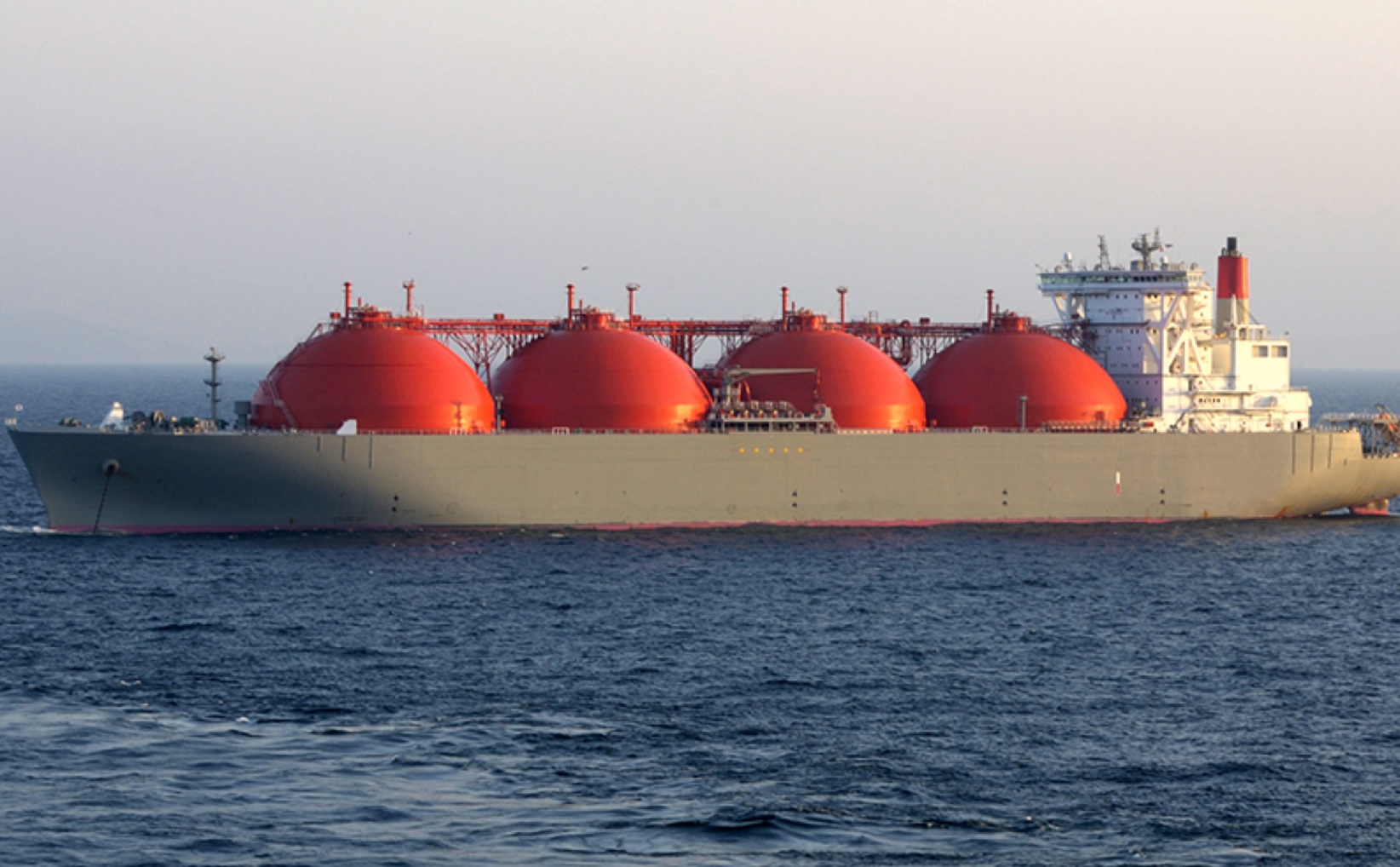
Technical note: The photo here is of an older Moss-style LNG carrier. Modern ships, called “prismatic” carriers, do not have spherical tanks, but rather utilize prismatic/angular tanks with flat, basically rectangular sides. The insides of these tanks are lined with high-nickel alloy steel sheets formed into “waffle” patterns which allow for thermal expansion and contraction, and which resist cold embrittlement. The tanks are surrounded by a substantial thickness of insulating material that keeps the LNG product cold (-162C), and that keeps the cold away from the ship’s hull, which is not designed for cryogenic temperatures.
Any new Alaskan LNG project would undoubtedly use these new-style ships, while the older Moss-style ships were used for much of the LNG exported from the shuttered Kenai LNG production project.
Well cool. The world doesn’t need our LNG! Sorry Dunleavy and conservative grifters. Let’s leave the gas in the ground – “conserve” it, as in conservative – and sell it when the demand is high.
So we ship lower 48 LNG or Australian LNG to Los Anchorage for power generation and home heating. That’s brilliant, Evan. You must be a prime consultant to Katarina Diesel.
.
I think railbelt residents would rather heat their homes with AK Gas. High paying construction and operating jobs, lower net transportation cost, likely cheaper as the State’s Royalty share.
Alaska should had developed more gas and oil production then this state could be contributing more and strengthening Americas global position; if Alaskans weren’t so government dependent.
I starting to firmly believe that life first has to continual worsening on Alaska first Alaskans living here before it gets better to where they start looking outside of their source of dependency upward on God. Alaskans are very Proud. There is only one thing to make a proud person see himself and be more reasonable and that’s wait for him to fall. Prayerfully the Church on Alaska remains a steady candle burning on the darkness so when proud people are falling they see hope they used to be dismissal of it until they are utterly broken. Then Alaska can start developing. Planning, and building.