


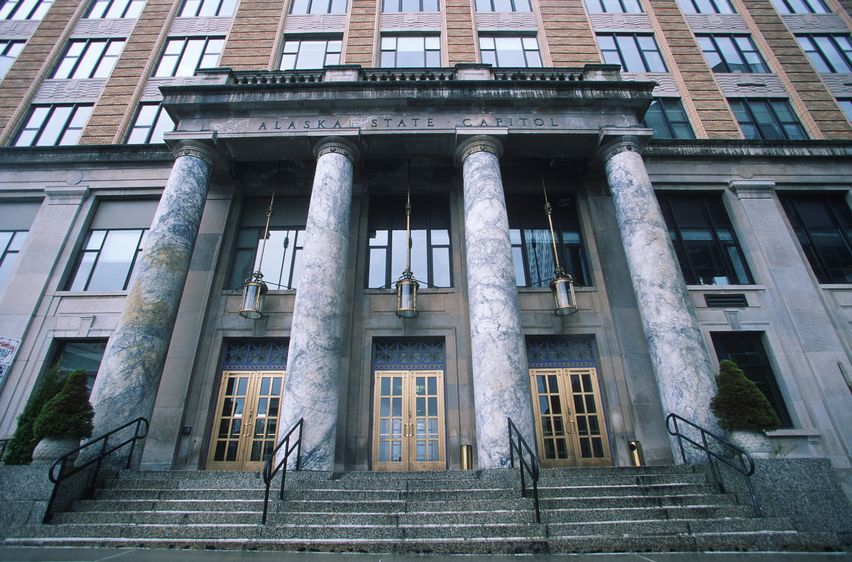
By BARBARA HANEY
March 26, 2026 – This week the House State Affairs Committee advanced CSHB 152(STA) on a 4-2 party-line vote. The committee substitute retains the core provisions of the original bill: a $150 flat head tax on wage and self-employment income and a 4% surtax on taxable income above $150,000 (single) or $300,000 (joint).
Proponents continue to project $300–350 million in annual revenue, primarily for education. My independent modeling, however, demonstrates that once behavioral responses are taken into account the net fiscal and economic outcome is substantially negative.
I applied a standard location-choice migration framework calibrated to Department of Revenue filer projections (413,850 returns) and IRS Statistics of Income data for Alaska, adjusted for anticipated 2025–2027 wage growth in oil, gas, and mining. The model incorporates semi-elasticities of migration drawn from the peer-reviewed literature on high-income mobility.
Under conservative assumptions, 1,079 to 2,158 high-earner households are projected to switch to nonresident status to avoid the surtax on non-Alaska-sourced income. This response alone erodes $5.3 million to $10.7 million in expected state revenue annually.
The downstream effects on local governments are immediate and material. The five largest boroughs—Anchorage, Matanuska-Susitna, Fairbanks North Star, Kenai Peninsula, and Juneau—would lose between $7.85 million and $15.71 million per year in combined property and sales tax collections as high-value homes enter the market and household spending declines. Mortgage portfolios, including the Alaska Housing Finance Corporation’s roughly $4 billion book and those held by local institutions such as Northrim Bank and First National Bank Alaska, would face $2 million to $12 million in additional expected credit losses and loan-loss provisions from modest price softening (0.4–1.0% base erosion in affected segments).
Resource extraction sectors, the backbone of Alaska’s economy, are particularly exposed. In oil and gas, with 8,000 high-wage rotational positions already 40.5% nonresident, an additional 384–768 workers are projected to shift residency, producing $1.3 million to $2.6 million in further revenue loss while raising effective labor costs and delaying projects. Mining, operating with a 44.2% nonresident rate, would lose $0.8 million to $1.6 million in direct revenue and trigger 440–880 indirect and induced job losses given its 2.2× employment multiplier.
Public education would also suffer. The migrating households average 1.1 school-age children, implying a reduction of 1,187 to 2,374 Average Daily Membership (ADM) students statewide. At the current Foundation Formula rate of approximately $6,200 per ADM, this generates an annual funding shortfall of $7.36 million to $14.72 million for school districts—equivalent to two to four years of the enrollment declines districts have already experienced.
Administrative costs compound the problem. The Department of Revenue’s fiscal note estimates $9.5 million in one-time capital outlays and $11–18 million in recurring annual expenses to support 70 new permanent positions and the necessary information-technology infrastructure. When these migration-driven losses are fed into REMI-style dynamic modeling, the aggregate effect on the Alaska economy is $400 million to $800 million in annual output reduction and 1,200 to 3,500 fewer jobs.
The committee substitute softened the dedication language and delayed implementation to Jan. 1, 2027, but it left the tax rates and structure intact. These changes do not alter the fundamental incentives the bill creates. Once high earners adjust their domicile—an adjustment they already make for Permanent Fund Dividend eligibility and other tax planning, the projected revenue gains shrink dramatically while the broader economic costs rise.
Alaska does not need another mechanism to tax its most productive residents. It needs policies that retain them. CSHB 152(STA) does the opposite. The numbers are clear. Members of the House Finance Committee now have the opportunity, and the responsibility, to reject the bill before it inflicts lasting damage on our fiscal position, our borough budgets, our key industries, and our schools.
Barbara Haney has a Ph.D. in Economics and Public Finance from University of Notre Dame. She served as graduate faculty and served as staff to the Illinois legislature prior to arriving in Alaska to teach at the University of Alaska Fairbanks in 1991. She worked for years on a federal grant teaching math and reading in rural Alaska through the Alaska Department of Labor and has served on the Fairbanks North Star Borough Assembly and the board of the North Pole Community Chamber of Commerce and is a member of the Greater Fairbanks Chamber of Commerce.
Barbara Haney: SB 190 raises concerns over costs, court burdens, and reduced legal protections



3 thoughts on “Barbara Haney: Why Alaska lawmakers should reject the proposed income tax”
Barb,
We need you in the Alaska State House.
Time for a change.
Here, here!
👏👏
Where do I send my donation? I’m done with Mike.