


March 17, 2026 – Ballots begin arriving in mailboxes across Anchorage this week, kicking off the city’s annual municipal election season. Voters have until April 7 to return their ballots by mail or deposit them in one of the municipality’s drop boxes.
Anchorage conducts its local elections entirely by mail and drop box, a system originally promoted as a way to boost voter participation. Turnout data from recent years suggests the change has not dramatically increased engagement. Participation has generally hovered between 25% and 35% of registered voters, with some variation depending on the ballot.
-
2025 (non-mayoral): ~23% turnout
-
2024 (mayoral election): ~30% turnout
-
2023: just under 28%
Even in years with higher-profile races, turnout remains tepid, challenging the theory that vote-by-mail boosts civic participation.
Six Assembly seats
This year’s ballot features races across all six Anchorage Assembly districts, each electing one member to a three-year term:
-
District 1 (North Anchorage – Seat B): Nick Danger, Sydney Scout, Justin Milette, Max Powers
-
District 2 (Chugiak/Eagle River/JBER – Seat C): Donald Handeland, Kyle Walker
-
District 3 (West Anchorage – Seat E): Brian Flynn, Anna Brawley
-
District 4 (Midtown – Seat G): Dave Donley, Kim Winston, Janice Park
-
District 5 (East Anchorage – Seat I): George Martinez, Cody Anderson
-
District 6 (South Anchorage/Girdwood – Seat K): Janelle Anausuk Sharp, Bruce Vergason, Zac Johnson
School board races and local service seats
Two at-large Anchorage School Board seats are also on the ballot:
-
Seat C: Alexander Rosales, Rachel Blakeslee
-
Seat D: Sharon Gibbons, Dustin Darden, Paul McDonogh
Various service area board seats—including road, fire, and local service districts—are also up for election, though many of these races are uncontested.
More than a dozen propositions, major spending
Perhaps the most consequential portion of this year’s ballot is a long list of bond measures and tax proposals that together exceed $155 million in potential spending and a major lift for property owners.
Key measures include:
-
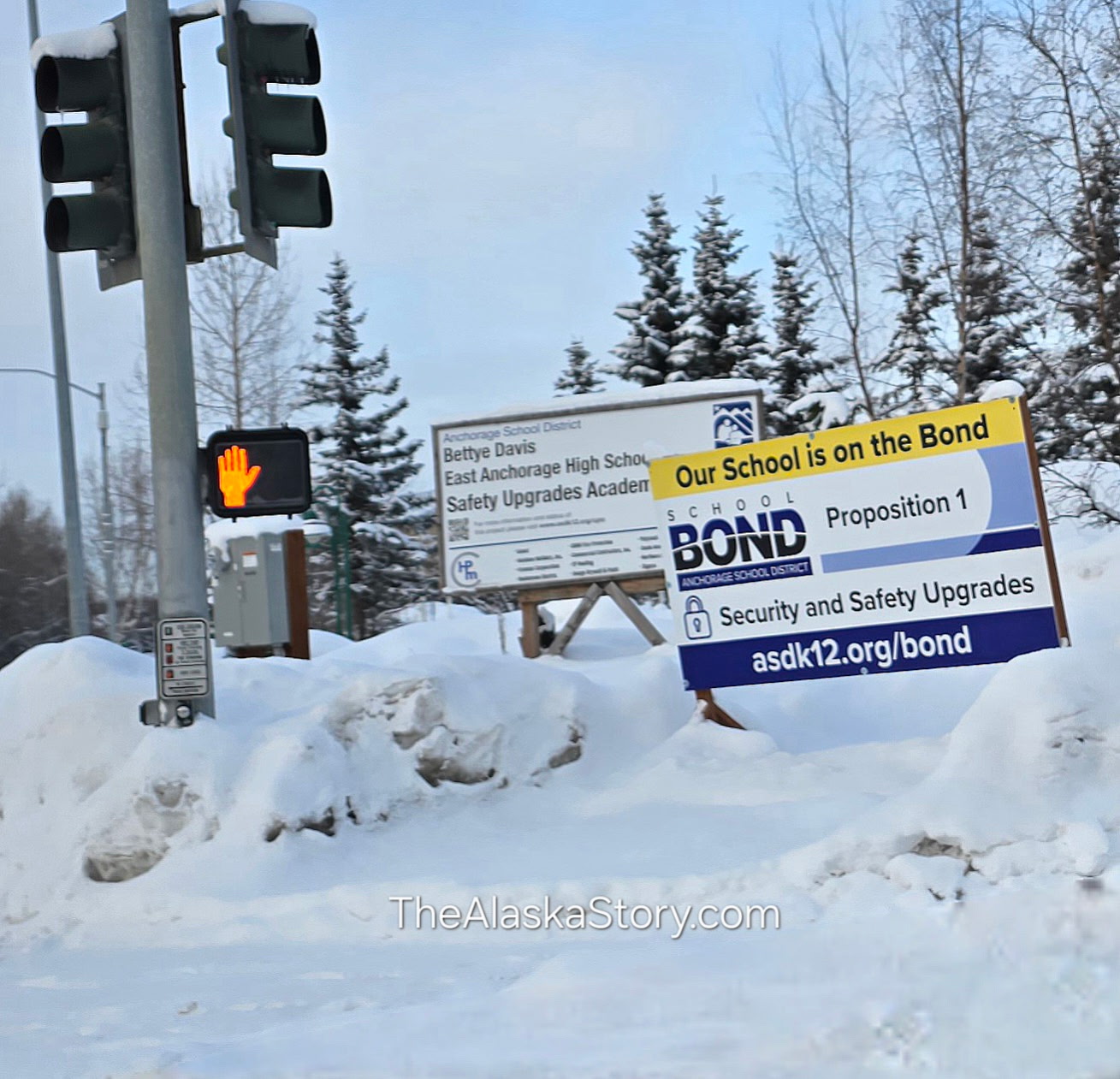
Proposition 1: $79 million for Anchorage School District capital improvements, including repairs to a school scheduled for closure
-
Proposition 2: Roads and drainage bonds
-
Proposition 3: Parks and recreation upgrades
-
Proposition 4: Police department facility improvements
-
Proposition 5–8: Additional bonds for community facilities, public safety, fire service, transit, and park access
In addition to the bonds, voters will decide on:
-
Proposition 9: A $12 million one-year property tax levy to fund Anchorage School District operations
-
Proposition 10: A technical charter amendment
-
Propositions 11–12: Local service area tax and infrastructure measures
If all bond measures pass, property owners could see a cumulative increase in taxes layered on top of prior years’ bond approvals.
If all the bonds pass in the Anchorage election, how much will you end up paying the city?
The election also comes amid controversy surrounding the Anchorage School District’s involvement in promoting bond measures.
A recent report by The Alaska Story documented concerns that the district may have crossed legal boundaries by advocating for passage of school-related propositions, rather than providing neutral information to voters.
School district crosses line, illegally advocates for passage of school bonds
Tracking your ballot
Voters can track the status of their ballots, from mailing to acceptance, through the municipality’s BallotTrax system:
https://anchorage.ballottrax.net/voter/
The city is also streaming live ballot processing and election updates online as results come in. The livestream is on YouTube.


2 thoughts on “Anchorage elections underway as ballots begin arriving in mailboxes”
Community councils have to meet Quorum requirements to continue as a body, voting should be that too else the consequence we lose our municipality or borough status because voters haven’t made voters quorum. Less than 28% voting, that’s not even a majority of 51%. That tells most people in Anchorage don’t want organization of a community, they just want to live and work.
Leftists have never met a bond they didn’t like. 99% of bonds are passed by mostly low information voters who drink the koolaid the leftists hand out through radio and tv ads. Every “home owner” becomes closer to a renter every time these bonds are passed.
As to vote by mail—-that must stop! We must have in person voting with voter identification after proof of citizenship was provided for voter eligibility. This part of the SAVE act must apply to ALL elections, even when voting to pass or reject bonds!
And the epitome of promoting fraud is RCV! This must stop!