


By THE ALASKA STORY
March 12, 2026 – New undercover footage released by the O’Keefe Media Group claims to show executives connected to companies affiliated with Alaska Native corporations describing how federal contracts are obtained through the U.S. Small Business Administration’s 8(a) Business Development Program and then largely performed by subcontractors.
The recordings focus on companies linked to Chenega Corporation and Cherokee Federal. The 8(a) program was created to help “socially and economically disadvantaged” businesses compete for federal contracts by allowing them access to set-aside and sole-source opportunities.
According to the footage, executives described a system in which companies with qualifying ownership structures secure large government contracts while subcontractors carry out much of the actual work.
In earlier footage released by the media group, a contract manager at ATI Government Solutions described how some firms operate after contracts are awarded.
“We only do 20%… the rest goes to subs,” contract manager Melayne Cromwell said in the recording.
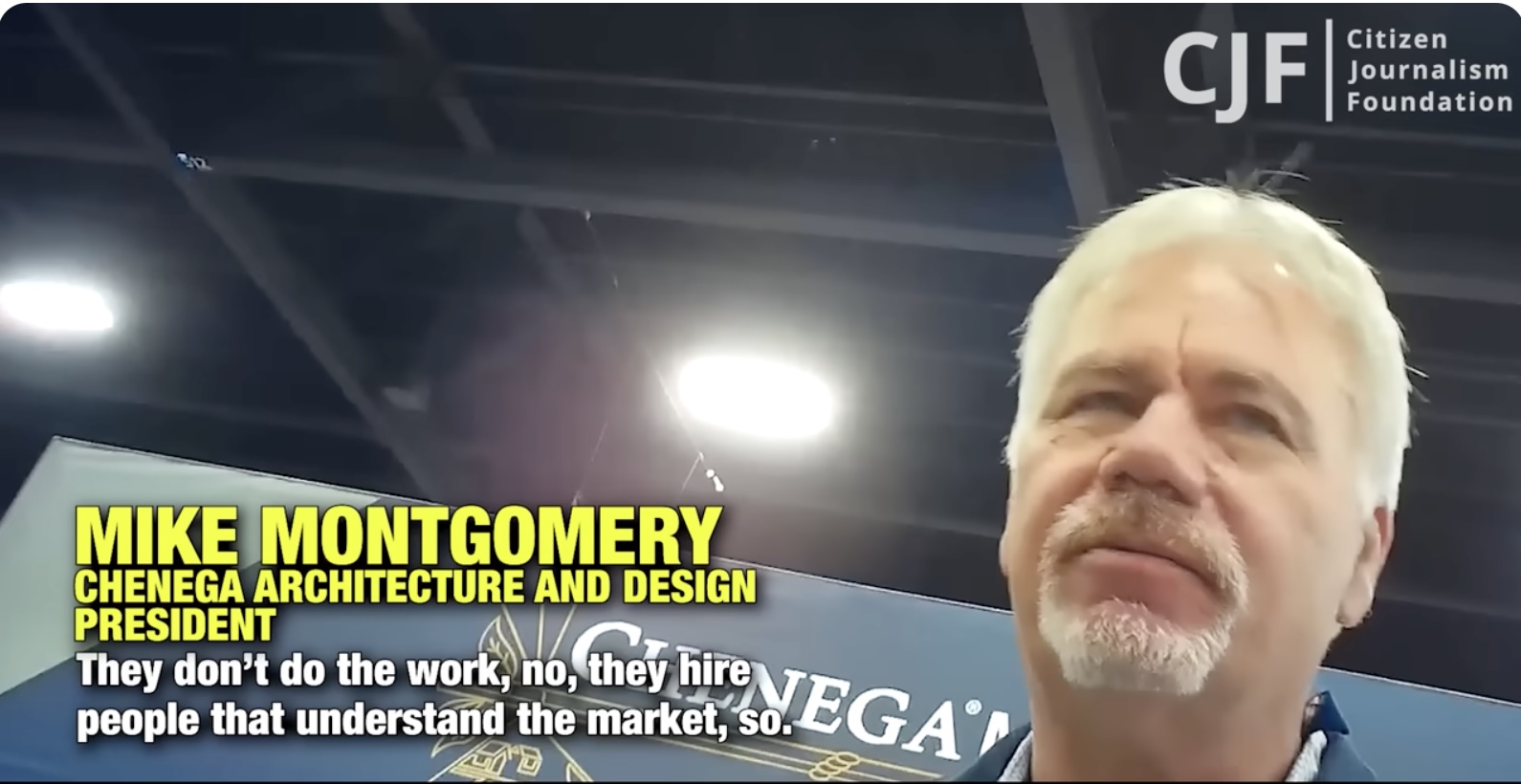
The latest undercover video includes comments from Mike Montgomery, identified as president of Chenega Architecture & Design, who explained that firms often hire executives familiar with federal procurement while relying heavily on subcontractors for project execution.
“They hire business executives that understand the federal marketplace… they don’t do the work,” Montgomery said in the recording released by O’Keefe Media Group.
In a separate recording, Ricky Longhurst, identified as a senior account executive at Cherokee Federal, discussed how contract revenue is divided between the operating company and the tribal entity connected to the business.
According to the conversation, Longhurst said roughly 63% of contract revenue stays with the company while about 3% is returned to the tribe. He also described how Native ownership status can make federal procurement easier to navigate.
During one exchange about the contracting structure, Longhurst commented, “It’s cheating really,” according to the footage released by the group.
The recordings also describe how companies may satisfy participation requirements by placing project managers on site while subcontractors perform much of the operational work.
Following the organization’s earlier reporting on ATI Government Solutions, Kelly Loeffler, administrator of the Small Business Administration, announced enforcement actions connected to the program.
The agency later confirmed that ATI had been suspended from the 8(a) program and that a broad review had been launched.
According to the SBA, more than 1,000 firms have now been suspended as part of what the agency described as the first comprehensive audit of the 8(a) program in nearly 50 years.
Chenega Architecture & Design Solutions describes itself as an 8(a) Alaska Native Small Disadvantaged Business and a wholly owned subsidiary of Chenega Corporation.
On its website, the company says it provides consulting, planning, and operational support services for federal clients and has served government customers for more than three decades.
The company states that its business model includes leveraging shared administrative services, technical expertise, and an ISO-certified quality management system across Chenega subsidiaries to compete for and execute federal contracts. It also notes that joint ventures allow the firm to combine expertise and expand capabilities when pursuing federal work.
The undercover recordings have renewed scrutiny of how federal contracting programs intended to assist disadvantaged businesses are implemented in practice.
The 8(a) program has long been a significant source of federal contracting opportunities for companies owned by Alaska Native corporations and federally recognized tribes. Those entities are permitted under federal law to receive certain sole-source contracts without the same dollar limits applied to other 8(a) participants.
The O’Keefe footage raises questions about whether the work performed under taxpayer-funded contracts aligns with the program’s actual intent.
Update: Chenega Corporation sent this statement to The Alaska Story in response:
Chenega Corporation categorically rejects the claims made in a video circulated by James O’Keefe and his organization. The video relies on selectively edited recordings that distort informal conversations and falsely suggest misconduct. O’Keefe continues to propagate three untruths: that Native federal contracting is supposed to be a Native employment program; that only small percentages of contract revenues actually make it to the Native people who aresupposed to benefit; and that Native companies are acting as conduits for other non-Native companies to obtain federal work.
First is his claim that Alaska Natives don’t do the work and therefore the program is some sort of scam. This assumes the goal is to employ Alaska Natives in federal contracting, which it is not. Alaska Native Corporations (ANCs) are included in the 8(a) Business Development Program to establish companies that create value for Alaska Native shareholders and communities. This is done by building Alaska Native–owned companies that employ people who can deliver cost-competitive, valuable services to the federal government. The right to participate in the SBA business development program is part of the value Alaska Natives received in compensation for giving up their lands to the State of Alaska and the federal government. Those lands included the oil-rich Prudhoe Bay and the land under the Trans-Alaska Pipeline, assets that have created more than a trillion dollars in value. Federal assistance in creating successful Native-owned and controlled corporations that bring value to individual Alaska Natives is part of the compensation for those lands.
Second, the report conflates total contract value with the benefits received by Alaska Native people. O’Keefe claims that “for every $100 … only $7 actually goes to the Native American,” citing $100 million and $1 billion contracts to sensationalize his point. This is misleading because it treats the total value of a federal contract as if it were all profit that should be distributed to Alaska Native beneficiaries. In reality, the vast majority of a contract’s value covers the costs of performing the work required by the federal government including wages, subcontractors, materials, and other necessary expenses.
It is typical in federal contracting for only a small percentage of total contract value to become profit to the owner. Equating contract value with direct benefit to Alaska Native shareholders creates a fundamentally misleading impression about how federal contracting works. For Chenega Corpora7on, 100 percent of our profits, a modest portion of total contract value, are reinvested to support the cultural, educational, economic, and social welfare of our Alaska Native shareholders. This is consistent with the purpose for which ANCs were created, while ensuring the government receives cost-effective, high-quality services.
Third is O’Keefe’s claim that “pass-through” contracting is common and that Chenega is guilty of it. Both are untrue. As an ANC, we do not see our peers violating SBA subcontracting rules requiring that at least 51 percent of the contract work be completed by the Alaska Native–owned prime contractor. At Chenega Corporation, our companies perform 100 percent of the work on many contracts. Where we do subcontract, it is generally because the government has asked us to bring in particular expertise. There is no scam here. The “pass-through” allegation is a myth.
For decades, Chenega has supported federal agencies with professionalism and integrity. We provide mission-critical services in national defense, security, and government operations. Our contracts, operations, and workforce practices fully comply with all laws and regulations. We employ the best experts in their fields and, in fact, more than 22 percent of our employees are veterans. Our successful business operations generate scholarships, dividends, and long-term investments that directly benefit Alaska Native shareholders and their communities. Alaska Native people relinquished their land claims in return for the promise of creating ANCs with the ability and resources to advance the real economic and social needs of Alaska Native people. Federal government contracting has proven to be an excellent and the most effective tool for supporting ANCs. Take away the ability to contract under the current rules, and the deal begins to fall apart. Are we going to get our land back? A deal is a deal, except often when it involves Native Americans. History tells us that whenever Native Americans receive something that turns out to be valuable or achieve some level of success, someone wants to take it away. Let’s not repeat history here.

14 thoughts on “Undercover recording raises red flag on federal 8(a) contracting involving Native-owned Chenega”
The original intent of the 8(a) program was for Native companies to be mentored by the government contractors so that they could do the work. The contract under 8(a) mentoring only lasts 8-9 years. However, instead of “teaching” the Native corporations how to do the work the contract ends and a new 8(a) corporation owned by a Native corporation is formed and the business continues. Native corporations have been doing this since 8(a) was made into law. Therefore, the expertise is never transferred to the Native corporations.
What you describe is exactly what was intended when ANCs were given access to the 8(a) program by Congress. This was done to fulfill part of the Government’s commitments under ANCSA. ANC subsidiaries consistently earn Satisfactory and above CPARS on their contracts. They are not abusing the program; they are utilizing it as it was intended.
The 8a and especially super-eight ANCs are nothing but scams. The whole program should be shut down….
there is too much Government dependency from people in America. It’s not so much the public assistance recipient who is taking more from the taxpayer nor the low income single parent and low income married couple with three children taking the child-tax credit worth a few thousand per tax refund. It’s you. the employee whose paychecks and benefits are dependent on the taxpayer. You combined with one hundred million other Americans couldn’t continue your lifestyle without the taxpayer paying coming through government.
This is why I point out currently AKRepublicans GOP can’t right size our own state government and reduce spending while many of its own leaders and members wealth is dependent continuing government spending.
Those two me I bet you anything they vote Republican. Not to just say Republicans are only taking advantage of the government. Because Democrats are also heavily dependent on government too. I recognize characteristics in those two men unique characteristics developed in what makes a voter lean right or left. Especially in the second one he is fighting against his conscience admitting what he is doing is Cheating.
Just as much as I recognized no parent who is low income is entitled to receive a child-tax credit worth 5000 or more (as much as it can help a working parent who is struggling while Americans who are single or making more don’t receive a tax refund because their refunds are going to the low income single parent or low income married couple in wealth distribution scheme.
do you honestly think the vast majority of disadvantaged minorities vote republican…?
The Native tribal members grieved at what they call a loss to themselves. What they are failing to understand is they are no more entitled to taxpayer money as the contractor has been scheming from the taxpayer. One thing I really hate about ANCSA, IHS, and state and federal programs supposedly for Native people it has kept Native people waiting for help instead of themselves going out, working, and making their own way to help their families out.
That woman in video saying her grandmother needs new installed insulation for her house. Then why didn’t the idea come to the granddaughter to first work and improve her own job so she herself can save up or utilize bank home equity loan or learn out Credit lines work so she can pay for her grandmothers home remodels. Why do Natives wait on others to do what family can do themselves. Why they don’t make their adult children living with them work to help take care of the family home. I seen one parent working while their three adult children over 18 still don’t work. That family is missing out on that 5000 every two weeks can be brought into one home between four working adults. i We don’t need tribal employments to reach the American Dream. We can work for another employer and even teach ourselves how to start a small business of our own using a talent one has.
Hate to say we told you so, but we told you so.
.
Have a look at “thealaskastory.com/murkowski-eyes-gavel-for-defense-appropriations-subcommittee/”.
.
The “Daily Wire” piece, with pictures, appears at: “How A Top Pentagon Contractor Enriches DC Insiders Using Law Intended To Help Eskimos”.
Anyone who has lived in Alaska for the last 30 years and not under a rock knows how the native corporations have been used to enrich a very small number of natives and a very large number of non-native parasites.
One phrase sums up the situation using 8A contracting as a form of subsistence hunting. Certain council members of the corporations are getting rich off of “the fat of the land”.
“the 8(a) Business Development Program (is) to establish companies that create value for Alaska Native shareholders and communities.”
That is a hellava deal. I want a program that “creates value” for me and my family.
The notion that Natives “owned” all of Alaska is specious. Native corporations received 44 million acres of land as part of ANCSA. Folks like Chenega want to pretend that ANSCA never happened and now come up with ideas repudiating it. BTW, the 8(a) program happened well after ANCSA.
It is time for Alaska Native corporations to grow up and stop looking for handouts, preferences and entitlements.
It would be helpful to see the salary structure/stats of both these companies starting from the top and going down. My guess is like public education they are equally top heavy.
How many Native Corporations have donated to Lisa Murkowski and Dan Sullivan and all the previous congressional persons including the present Rep Begich? How many corporate Native boards in Alaska have Murkowski or Sullivan or any pf the previous congressional persons on their boards, present or past membership? How much donated over the years and how many bills in congress in the past as well as today, as Murkowski just stated she was in the process of doing? How much money has the tax payors out of to keep butt lazy Indian and Natives in money to give away work to someone who should serve the needs of these butt lazy people? They have as many opportunities as any one to raise their communities and themselves up. Why are the congressional persons and any others so intent on not giving them their responsibilities as human beings to themselves and their communities? The Native corporations and tribal Indians always have a few that put up a good fight for the good life they want and will work for but not all in their corporate and Indian structure. For those in these corporations and tribal peoples who have worked hard to develop and create their histories, then look to the few who have done good and some seriously great things for their people and stop initiating issues that lead to the destruction of all your corporate and tribals works. Congressional persons have a job to do but not in your back pocket or the center of your homes and families. That job is native and Indian. There are all kinds of addictions and the congressional persons past and present are and have created money addictions that lead no where but down.
Chenega Corporation, one of the largest corporations in Alaska by revenue, is not a small business and, therefore, is not the intended target of Section 8(a). It literally does not qualify as a Section 8(a) business. The law specifically references “small business concerns.” 15 U.S. Code § 637.