


By SUZANNE DOWNING
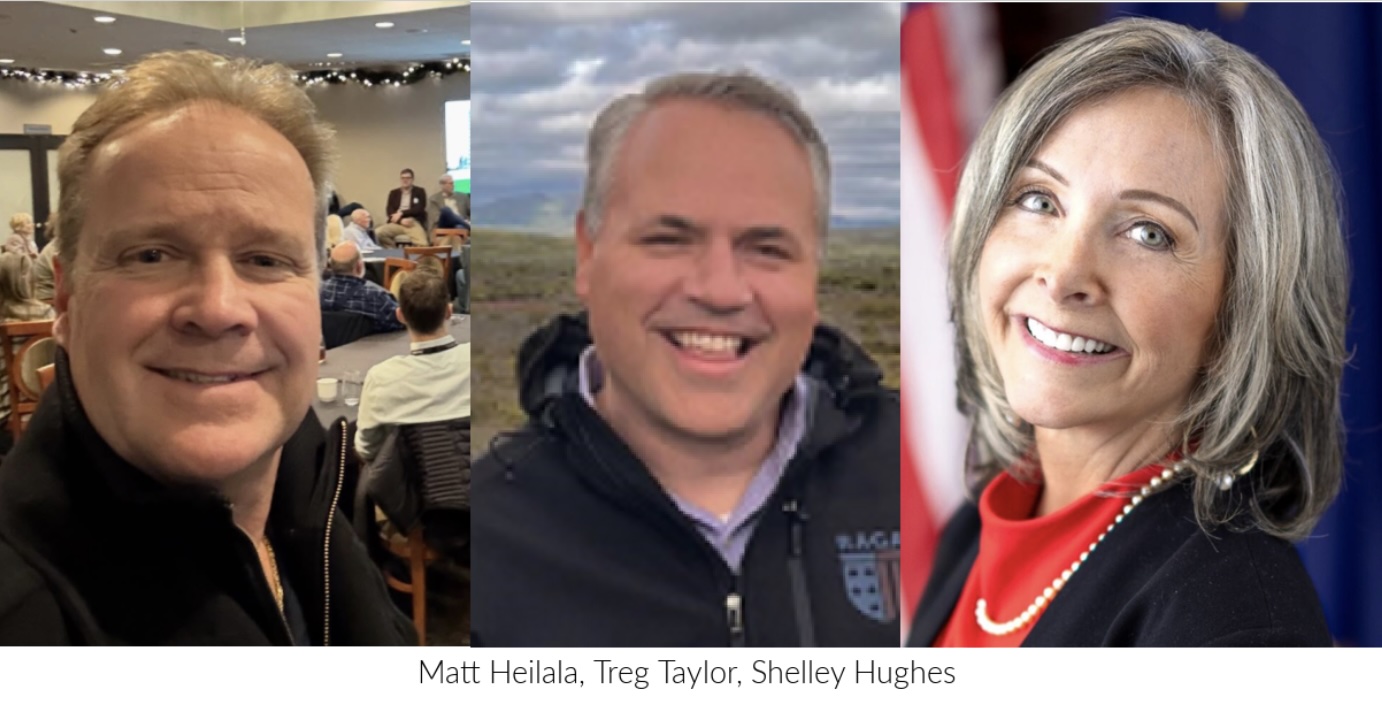
Feb. 18, 2026 – Alaska physician and gubernatorial candidate Matt Heilala has set a new financial benchmark in the 2026 race for governor, reporting more than $1.36 million raised in his year-start campaign filing with the Alaska Public Offices Commission.
Heilala’s report shows $114,000 in contributions from donors, but the overwhelming share of his campaign war chest comes from his own checkbook: $1.25 million in personal funds. Heilala filed in July and has indicated he is willing to spend more, as needed.
The filing establishes Heilala as not only the most heavily financed candidate so far, but likely the most self-funded gubernatorial contender in Alaska history, as the crowded governor’s field took shape at the first financial disclosure deadline. He has spent $354,756 so far in his campaign efforts.
But Heilala is not the only candidate investing heavily in his own campaign.
Former Alaska Attorney General Treg Taylor, who entered the race after serving in the Dunleavy Administration, has reported raising a total of $880,309.
More than $287,566 of that total came directly from Taylor himself, including in-kind contributions, placing him among the candidates leaning on personal resources to build early momentum. Nearly a third of his contributions were from his own pocket.
Taylor had spent $155,678 on campaign expenses, as of the filing deadline.
Former state senator Shelley Hughes, a Palmer Republican with deep ties in the Mat-Su Valley, has also reported $306,000 raised, with $200,000 coming from her own personal funds, about 65% of the total. Hughes’ report adds to the theme that self-financing is becoming a notable feature among contenders seeking to break through in the crowded field of 17 candidates.
While several other candidates have reported strong early fundraising through traditional donor networks, none have approached Heilala’s level of personal investment.
Former state health commissioner Adam Crum reported raising $347,000 in his first 90 days, with 209 individual donors and a majority of contributions coming from within Alaska. He contributed a more modest $60,000 of his own funds.
Anchorage Democratic Sen. Matt Claman reported $229,407 raised since filing in November, drawing support from prominent legal, union and political networks.
Former Anchorage Mayor Dave Bronson announced he has raised more than $217,000 since entering the race. Between Bronson and his lieutenant governor candidate Josh Church, they put in $32,000 of personal money.
By contrast, Heilala’s campaign is operating on a different financial scale, largely fueled by personal wealth rather than broad donor support.
Other statewide candidates have filed far smaller totals.
Lt. Gov. Nancy Dahlstrom reported raising nearly $18,000, while former legislator Edna DeVries reported raising nearly $11,000, placing them among the lower-funded candidates so far in the early reporting period.
With an historic number of candidates now filed or actively campaigning for governor, fundraising has become an early measure of seriousness and viability.
The year-start APOC deadline arrived Tuesday at midnight, with Taylor bringing up the rear as one of the last to file disclosures on the Republican side.
More updates are forthcoming today.


17 thoughts on “Self-funding emerges as theme in governor’s race”
Will a mostly self financed campaign appeal to voters? We shall see, hopefully not.
If Joe Hayes in 1986 is a good indication, the answer is a clear no.
Adjusted for inflation, how does Heilala compare to Wally Hickel? Just off the top of my head, Hickel spent somewhere around $2–3 million of his own money across four campaigns to regain the governorship (1974, 1978, 1986 and 1990).
Randall, I am curious why you think a self-funded campaign is less appealing to voters. It’s just money, which will buy ads, consultants, etc. just like any campaign financed by donors.
These facts strongly suggest that we pay doctors and lawyers too much.
No way Nicholas is getting a dime from the Begich Family Trust. The Trust is for Democrat family members only. Since Tom and I are the Trust Babies in this family, Nicholas is on his own. Thankfully, neither Tom nor myself have ever had to really work for a living. So glad that we hung around in politics. Free money from other people is the only way to go.
Thank you for saying it like it is, Bro.
So-called NB3 is an imposter to the Begich Clan. We’ve never allowed Republicans or Conservatives into our tight little group of esteemed nobles and heirs to Alaska politics. And worse, he backs President Trump. And Dan Sullivan. NB3 has gotta go.
Doctor of Podiatry: High school grades in academic courses good enough to get into college; four years of college preferably in laboratory subjects like physics, chemistry, and biology; four years of graduate school at a Podiatric College to earn a Doctorate in Podiatric Medicine (D.PM.)…(Dr. Heilala graduated Valdictorian of his class); upon graduation successful completion of clinical training and Residency with hands on experience in Podiatry and foot surgery, at a hospital, clinical facility or practicing Podiatrist. Upon completion sit for and pass state licensure and Board Certification exams. Median salary: $141K. Dr. Heilala was in practice for 30 years. In 2000 he started a Podiatric and Foot Specialists Group of doctors…reflecting both medical and business expertise (along with risk, time, and effort). If some think he has been paid too much, I wonder how much they feel he should he be paid? It would seem if folks believed doctors are overpaid, more of them would be signing up for the 10 plus years of college and training to earn the easy bucks. …and if they did, increasing the labor supply, salaries would come down.
My response was to JMARK.
The good doctor is a breath of fresh air and puts the dead beats from the Dunleavy administration between a rock and a hard spot. I’m so glad to see new people with much better vision for Alaska. I’m sick of the airheads and deadbeats that spend more time perjuring themselves while supposedly representing workers for Alaskans. Good bye Dunleavy dead beats!!
Diana, I am leery of medical professionals turned legislators. Most of them take their “superior” attitude from the clinic to the legislature. Having watched Cathy Giessel over the years and her “I know what is good for you” approach to law making, I will reserve judgement of Mr. Heilala’s intentions and goals for the state. Since I seem to be unable to locate a campaign website via an internet search for him, I can not even consider his platform and it does not speak well of his ability to communicate with potential constituents (and no I will not use a QR code to see his site)
Adjusted for inflation, how does Heilala compare to Wally Hickel? Just off the top of my head, Hickel spent somewhere around $2–3 million of his own money across four campaigns to regain the governorship (1974, 1978, 1986 and 1990).
The amount of personal, Alaskan resident, that makes donations amount to a vote of confidence. Self pay to me is like using your own finances to pay for your allowance . I wish there was some method to cap the campaign limits. This would show how well each candidate was able to monitor their spending for their best return . Watch the APOC statements for large groups investing in control of a candidate.
Jodi Taylor has been working the mormons and family these last few weeks to get the numbers up so at the time of disclosure, Treg would have the most money once personal contributions are removed.
You forgot Bernadette.. Yesterday? she was listed as $305,++++
Someone should review the campaign finance reporting filed by gubernatorial candidate Treg Taylor.
1. Inflated or poorly documented personal in-kind contributions
The reports include a long series of personal in-kind donations described as approximately $65 “meals with grassroots.”
These entries do not clearly identify:
the vendor,
the specific date of the expenditure,
the event or purpose,
or the individuals involved.
The repeated use of identical amounts and vague descriptions raises concerns about whether these entries reflect actual documented expenses or estimates. It would be appropriate to confirm that receipts and supporting documentation exist.
2. In-kind travel reporting lacks required detail
The campaign reports substantial in-kind travel attributed to the candidate personally. However, the entries appear to lack:
specific travel dates,
itemized cost breakdowns,
trip purpose,
and event descriptions.
Many figures appear rounded, which makes it difficult to determine how valuations were calculated and whether they reflect actual expenditures.
3. “Non-Monetary Alpha Media Credit” – $9,000 (11/25/25)
The report lists a $9,000 non-monetary credit from Alpha Media dated November 25, 2025.
However, Alpha Media was publicly sold in August 2025 and became part of Connoisseur Media. This raises several questions:
Which entity actually provided the credit?
What is the nature of the credit and what services does it represent?
Why is the description not more specific?
Could this represent a prepaid credit that inflates reported income before services are delivered?
Clarification and documentation appear warranted.
4. Vendor payments lacking adequate description
Several vendors are listed without meaningful descriptions of services provided, including:
1892
Sugarhouse Strategies (identified as the candidate’s daughter’s company)
The filings do not clearly describe the services performed or the scope of work. Greater detail is typically expected, particularly where potential conflicts of interest may exist.
5. Overall reporting quality
Given the candidate’s professional background as a former Attorney General and business professional, the overall lack of clarity and specificity in these filings is concerning. Campaign finance reports should allow the public to clearly understand the nature of contributions and expenditures without ambiguity.
“But the overwhelming share of his campaign war chest comes from his own checkbook:$1.25 million in personal funds. Heilala filed in July and has indicated he is willing to spend more, as needed.”
.
Damn, sports fans, why even bother with an election?
.
What a line-up. Education industry’s guy got some for his mob, now the medical/insurance/pharmaceutical industry guy’s up, got to get some for his mob.
.
Pony up a mere $1.25 million, you too can rent the Governor’s house for four years, maybe more, for another $1.25 million. Surprised the place didn’t show up on Airbnb, hope it comes with sheets and towels.
.
Surely nobody in his right mind believes Matt won’t get his $1.25 million back, plus a whole lot more?
.
Good thing voters don’t take Matt as seriously as he takes himself.