


By SUZANNE DOWNING
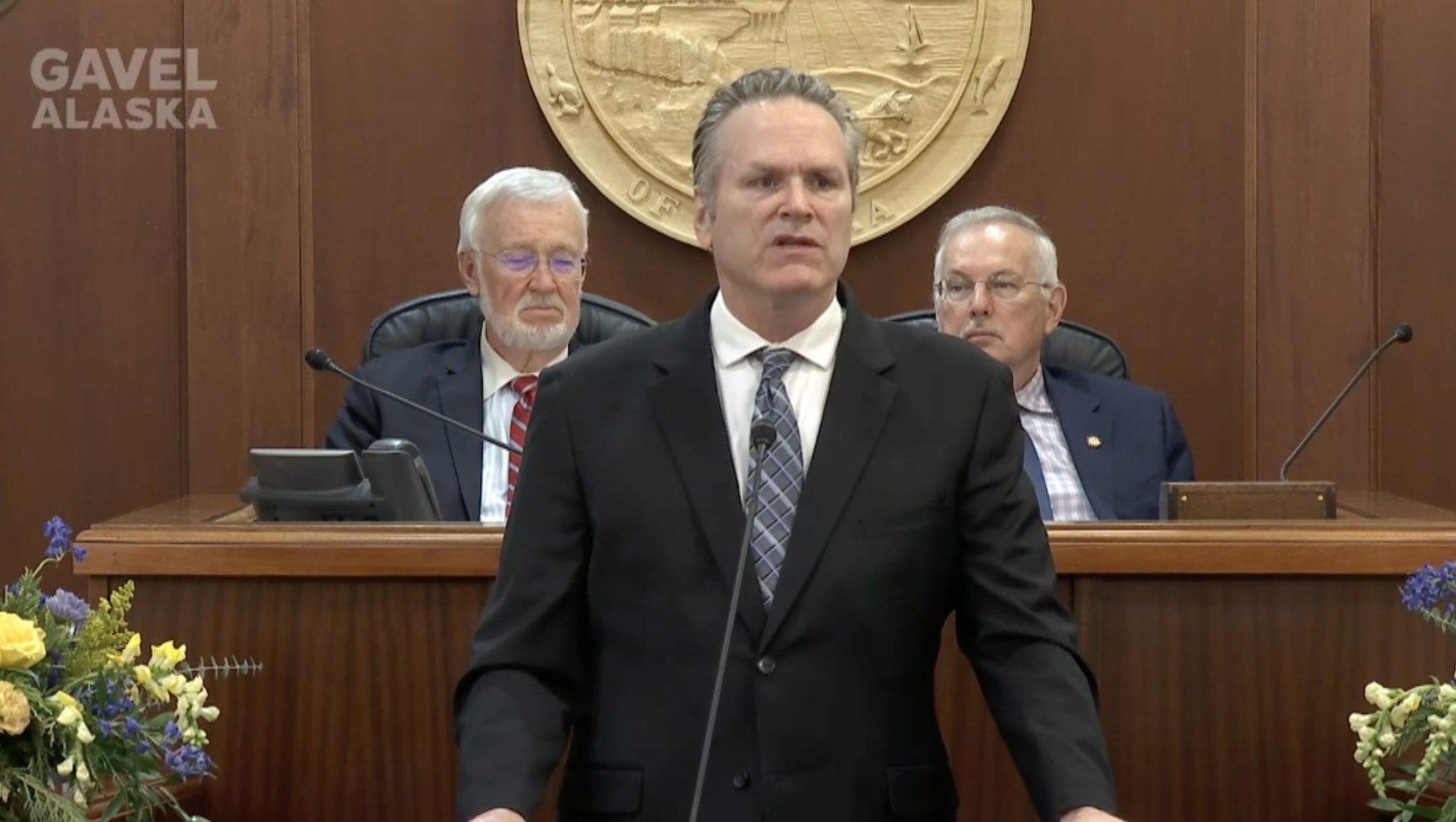
Gov. Mike Dunleavy used his eighth and final State of the State address Thursday night to cast his last year in office as a choice between what he called an “Alaska-centric agenda” and the influence of “special interests,” while promising a new fiscal package aimed at stabilizing the state’s boom-and-bust budget cycle and leaning heavily into the White House’s renewed push for Alaska resource development.
“It’s going to be a long one,” he warned and it was a long speech — almost 90 minutes altogether.
“This is my eighth and final State of the State address to you, and the people of Alaska,” Dunleavy told lawmakers at the start of the remarks, framing the evening as both a closing argument and a roadmap for the final year of his administration. He thanked the people of Alaska for putting their faith in him for the past seven years.
Dunleavy quickly moved into pointed civics lesson, emphasizing that the governor is not an extension of the Legislature. “The people of Alaska put me in this role to serve you as governor for the people of Alaska.” He thanked the people of Alaska, and said that after marrying his wife and having three daughters, “serving the people of this great state has been the best decision of my life.”
The governor also took aim at what he described as entrenched influence in the Capitol, saying he intended to keep resisting groups who “walk the halls of Juneau looking for opportunity to push their own agenda.”
“These are the groups [special interests] that will have a party the day I leave office,” he said, adding, “that is understandable because I haven’t been very accommodating to them while I have been in office. That won’t change this year, either.”
To the legislators, he reminded them there are three branches of government. “I don’t necessarily work for you, I am not a 61st legislator, nor do you work for me,” he said. “We work together on behalf of all Alaskans.”
Dunleavy inherited disasters from the day he took office, and they kept coming. Under his watch the state has endured 85 state and federal disaster declarations during his tenure, “an average of one per month while I’ve been in office.” Pandemics, snow storms, fires, floods, typhoons, and more.
He highlighted the response to the remnants of Typhoon Halong in Western Alaska, describing rescues, evacuations, and rapid damage assessments using drones and remote connectivity, and he publicly recognized state and federal leaders involved in those efforts.
“They are absolutely the best,” he said offering a round of applause for the emergency management personnel of the state. He said he had heard from others around the country that Alaska has the best disaster response in the country.
Then there was the manmade disaster of the Biden Administration. Dunleavy sharply contrasted that with President Donald Trump’s second term. And he praised Trump for signing a first-of-its-kind executive order “specifically for Alaska,” and said the administration’s posture has boosted investor confidence and accelerated permitting and development. Dunleavy cited federal transportation funding, oil and gas policy changes, and a permitting agreement tied to FAST-41 as examples.
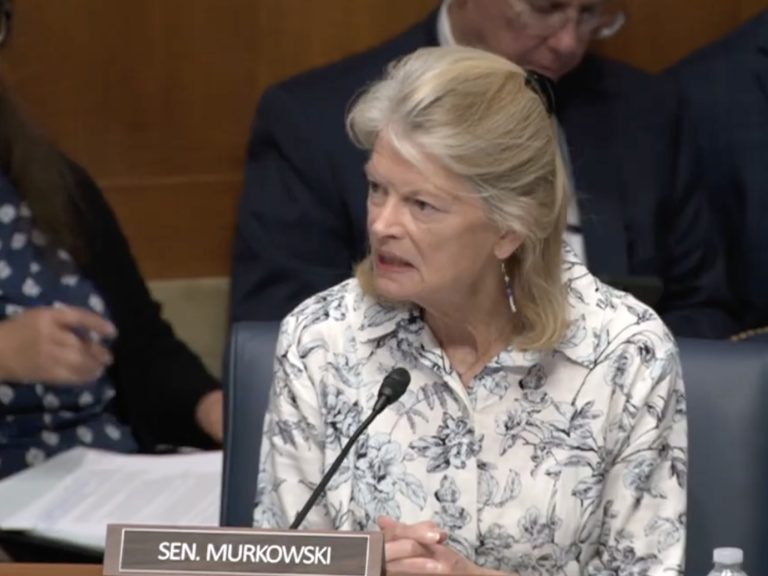
It signaled that Alaska is open for business he said. And he led applause for President Donald Trump, which was not joined by the Democrats and their several Republican allies, like Sen. Cathy Giessel, who caucuses with Democrats.
“We finally have a president who believes in Alaska and wants to unleash our resources for the benefit of our people,” he said.
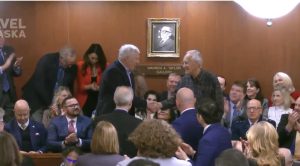
Dunleavy introduced his longtime friend Dick Randolph, who founded the Libertarian Party of Alaska and was the first Libertarian elected to office in the entire United States. He also introduced his longtime friend John Sturgeon, who won access to lands and waterways for Alaskans, not just once, but twice at the Supreme Court.
A central theme of the address was Alaska’s recurring fiscal instability. Dunleavy said the state’s reliance on oil revenue has turned the budget into a yearly fight that crowds out other policy and discourages investment.
“We have a problem, and we can solve it, this year, under my watch and yours, by working together,” he said, promising to introduce legislation within days. Reportedly, he has a sales tax and an oil and gas tax package in the works.
Dunleavy has already previewed that his fiscal package will include a temporary, seasonal sales tax.
He also said Alaska “can’t continue to fund government by shrinking the PFD,” calling last year’s dividend the smallest in history when adjusted for inflation.
Public safety: Crime and a focus on Anchorage
Dunleavy devoted a large portion of the speech to public safety, repeating his message from earlier years and pointing to expansion of troopers, Village Public Safety Officers, and specialized investigative units.
He tied fentanyl enforcement to both policy changes and personal tragedy, telling the story of Bruce Snodgrass, who died of overdose, and the federal “Bruce’s Law” effort championed by his mother Sandy Snodgrass.
The governor singled out Anchorage as the state’s biggest outlier, listing shares of murders, sexual assaults, car thefts, robberies, and overdose deaths, and announced a joint effort with the Municipality of Anchorage starting with retail theft and public nuisance crimes before moving to drugs and violent crime.
If Anchorage statistics were removed from the mix, the state has seen a sharp drop in crime. 41.8% overall crime rate has dropped since he came into office. Violent crime is down 19% robbery is down 33%, motor vehicle theft is now down 55% since repeal of SB 91, the catch-and-release legislation, he said. “If you take Anchorage out of the mix of our overall crime rate, our state’s overall crime rate is well below the national average,” he said. 38% of state population but 55% of state murders and 78% of state robberies. in 2024, 74% of deaths from drug overdose were in Anchorage. Violent crime in Anchorage is 3 times national average, higher than New York, LA, Chicago, and DC, he said.
He said he is committed to work with Anchorage’s mayor to work together to attack the overall crime rate. An initiative targeting retail theft, and street crimes. Later, violent crime, assaults, rapes, and murders, will be targeted by early this spring.
If crime is down, wages are up, and growing faster than the national average.
“Our economy has been getting stronger and stronger under my administration and diversifying as well,” he said.
Education: the Alaska Reads Act
On education, Dunleavy held up early Alaska Reads Act benchmark gains as evidence that policy changes can produce results, and he pressed lawmakers to act on additional proposals including charter school access, open enrollment, and incentives tied to teacher retention.
He criticized the Legislature’s pace by comparing Alaska’s typical bill count and slow progress to other states’ faster sessions, arguing that time is not the limiting factor.
Alaska LNG: the speech’s biggest economic headline
Dunleavy portrayed the Alaska LNG project as the defining economic bet of the next decade, repeatedly calling it transformative — “the single most transformative project in Alaska since the Trans-Alaska Pipeline.”
He credited Glenfarne with accelerating project development since taking the lead role and cited a string of agreements on gas supply, pipeline construction, and in-state offtake, including with ENSTAR and Donlin, plus a shipping partnership with Danaos.
Only two hours before, Glenfarne rolled out a massive announcement that said the company has moved into the execution phase.
He also previewed upcoming “conversations…about tax policy that could impact the cost of gas to our residents,” arguing the state must ensure the “lowest cost of natural gas possible for Alaskans.”
Oil production has increased and the Permanent Fund has reached record highs, he said.
A farewell theme: optimism, “North to the Future,” and one last year to govern
Dunleavy closed by positioning his final year as unfinished business urging lawmakers and voters to seize Alaska’s moment in resources, technology, logistics, and Arctic position.
“The future is not something that happens to us,” he said. “It’s something we choose, through the policies we adopt, the courage we show, and the faith we place in our people.”
“This has been the greatest honor of my life,” Dunleavy said. “Alaska’s best days are not behind us, they are ahead of us.”
2 thoughts on “Dunleavy closes out his final State of the State speech with fiscal plan push, Alaska LNG momentum”
The general theme of the Democrats I get through my district’s two Democrat legislators is Not North to the Future but one to return Alaska backward in time back to what they think was the good ol days
I hope for Alaskans to see the sharp contrast between leaders to decide which ones want to move singles and families forward Eventhough we may endure short-term hardships to becoming independent and prosperous versus those leaders who want us shackled and dependent
2027 will be here before we realize it when we will see if Alaskans want to move forward or go backward in their lives
2027 isn’t just any election year its a pivotal moment in Alaska history and Republican leaders and the few Alaska voters should take it more seriously than they take elections seriously
Again passing the buck onto our state’s summer visitors is Not a hospitable action to do on our visitors who wanted to come to Alaska for a vacation which for many travelers Alaska was a longterm dream of their’s
Not because of necessity but because of our state’s irresponsibility on how to properly manage a billion dollar budget and our failures to live below its means
Passing the buck on to summer visitors would be like a property owner raising his rent on all his tenants because now he has to pay for his children’s private school tuitions so he’ll make his tenants pay for his children’s private school.