


By RODNEY DIAL
Our town, like most, has a shortage of affordable housing options. In Ketchikan, years of economic growth, a mild climate, and proximity to the Lower 48 have contributed to a high number of non-resident home sales, higher rents, and a reduction in low-income housing options.
A few months ago, we became aware that a local young person whom we are quite fond of was in the process of being evicted from her apartment. Many young adults in Ketchikan need roommates to afford housing, and in this case, she had lost her roommate and was no longer able to afford existing housing options on her own.
After realizing that another apartment was simply not an option, we considered helping by purchasing an RV for a living space. Modern RVs are self-sufficient and comfortable, but their greatest downside is that there are few places to legally park them without attracting the wrong type of attention. Local government code, HOAs, and large property owners will quickly run off anyone living in an RV after more than a day or two. Even in communities that have RV parks, the nightly fee approaches that of a low-quality hotel and can be prohibitively expensive.
Many YouTube videos later, we learned that for hundreds of thousands of Americans, the only housing option they can afford is living in their car; or preferably, in a van. A term frequently used for this type of lifestyle is “stealth camping.” Non-RV vehicles can blend in and be used successfully for shelter, moving occasionally to avoid attracting attention.
A van is considered one of the best vehicles for stealth camping, especially a white work van. White vans are common and seen everywhere. Converted into a tiny home on wheels, they can become almost invisible. That seemed our best option, so we developed a plan to find one and convert it into a living space.
The search was short, as we quickly found an old white work van on a local used-car lot. It was a former municipal vehicle from the Lower 48 that drove well and still had plenty of life left in it.
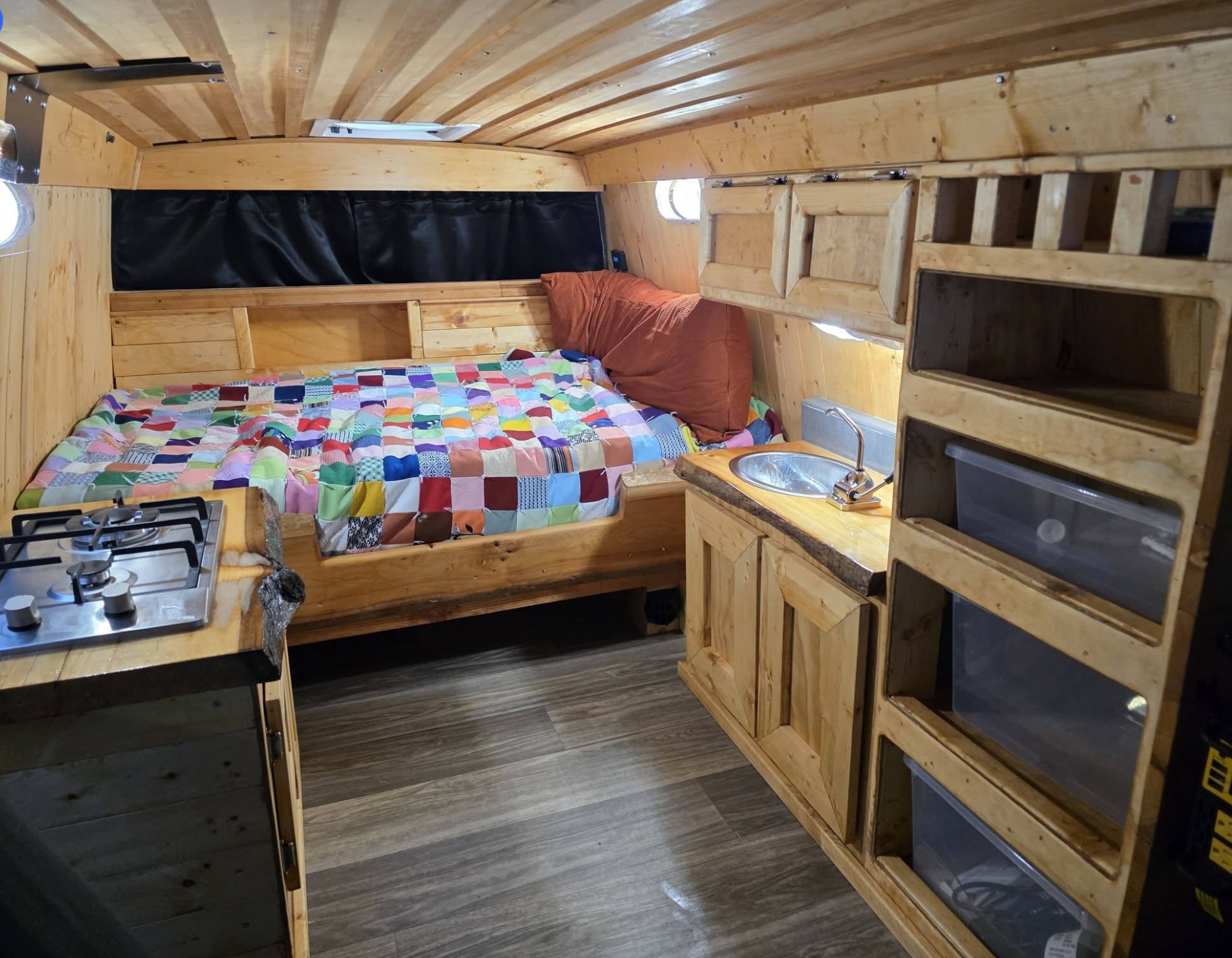
We spent just over $6,000 on the vehicle and brought it home, placing it in our garage for conversion. The goal was to build a living space my wife and I would be proud of; built with quality and love, but on a budget. Immediately, I got on Amazon and ordered many of the supplies we would need: a solar kit, various electrical components and lights, a propane stove, Chinese diesel heater (awesome and affordable), a basic water pump, and more. Scrounging locally, we obtained some items for free, like a used sink and water tank. In Southeast Alaska, driftwood is everywhere, and I had previously used my “Alaska Sawmill” (a chainsaw attachment) to cut live-edge planks that I would use for countertops.
While we waited for our Amazon loot to arrive, we focused on cleaning, insulating, constructing floors, and building cabinets. With the exception of a few pressure-treated items, everything was made with “welfare wood” (the local term for the cheaper stuff). When building in a van, one of the first things you notice is that the walls are curved, which adds to the challenge of the build.
My wife and I worked with a purpose; we had about a month to get this done. Between us, we invested about 200 hours in this project. In the end, it became a cozy, dry, self-sufficient home. Lights and electronics are powered by a solar system, backed up with a DC charger when the vehicle is running, or shore power if available.
The total we spent on this project was about $11,000, including the vehicle. The cost to live in it is minimal. Ketchikan allows permanent, one-time registration of vehicles, so there is no additional registration tax that will ever need to be paid, and insurance for vans is pretty reasonable.
For us, the larger lesson from this project is that unless local governments and states learn how to live within their means and stop the never-ending cycle of tax increases, they can expect an increasing percentage of their citizens to look for housing options like this.
Rodney Dial is the former mayor of Ketchikan Gateway Borough and now serves on the borough Assembly. He is a retired state trooper.


8 thoughts on “Rodney Dial: A van remodel demonstrates the hard truth about housing prices in Ketchikan”
Can’t the retired ferry, Malaspina, be converted into a floating condo with common areas for food, recreation, and entertainment? Malaspina is sitting in the water in Ketchikan right now. Cheap state property with a waterfront view.
John Binkley bought the Malaspina in a no-bid, sweetheart sale by the Transportation Commissioner, Ryan Anderson. $170K. It floats, but not good enough even for Motel 6.
Thank You God!
He’s answering prayers. More Alaskans are uplifting one another with doing something instead of complaining and acting helpless.
Great news to hear non druggies and non alcoholic Alaskans are thinking outside the box to the problems we brought on ourselves to get solutions that somewhat gets us out of them.
While we wait on current community leaders to think outside the box that we boxed them into because we won’t make sacrifices in having the state and local budgets reorganized so communities are living below what private sector revenue it does take in.
Something else I pray for is I want to see more Alaskan men building staring with car/truck/van camper conversion projects just to be doing something than just sitting around watching sports, stupid movies, or watching p-word. Because men by nature are Builders. If they aren’t building something. They are tearing something apart.
On Craigslist and impound auctions I see lots of beautiful SUV’s, Vans, and buses that could be rebuilt into homes while I look around and don’t see men doing much of anything and getting more depressed each year.
Nice job Rodney. Bless you for sharing this space with a neighbor in need.
We need the City land developed for affordable housing. In Juneau it’s only available for contractors to develop expensive large homes.
Trailer parks size small lots for small homes nearly unheard of.
Regulations make options unavailable. Think about how many of us have transitioned by living in a not so mobile self contained home.
I’ve considered taking a job in Ketchikan and a few other communities in SE, each time when I look at the cost of housing the thought of moving back to my place of birth stops me from pursuing employment there. The jobs I’ve looked at pay in the six figures but I can’t find a reasonably priced house for sale. These small communities need more available land. The land held by the feds, state, boroughs, and towns need to be opened for development. Converting a used van for $11,000 isn’t a sustainable way of providing housing to people who are contributing to society, especially if those people ever want a family.
The curse of Sarah Palin again. She sucked so much oxygen out of the Gravina Island Bridge dialogue, most people managed to ignore what Lew Williams Jr. had to say about the development opportunities Gravina provides.
Stealth camping is frequently just plain old trespassing. Not cool buddy. I always run them off my property in the wee hours of the morning. Just amazing how indignant they act.
Retired State Trooper? Really? Wow.