


By SUZANNE DOWNING
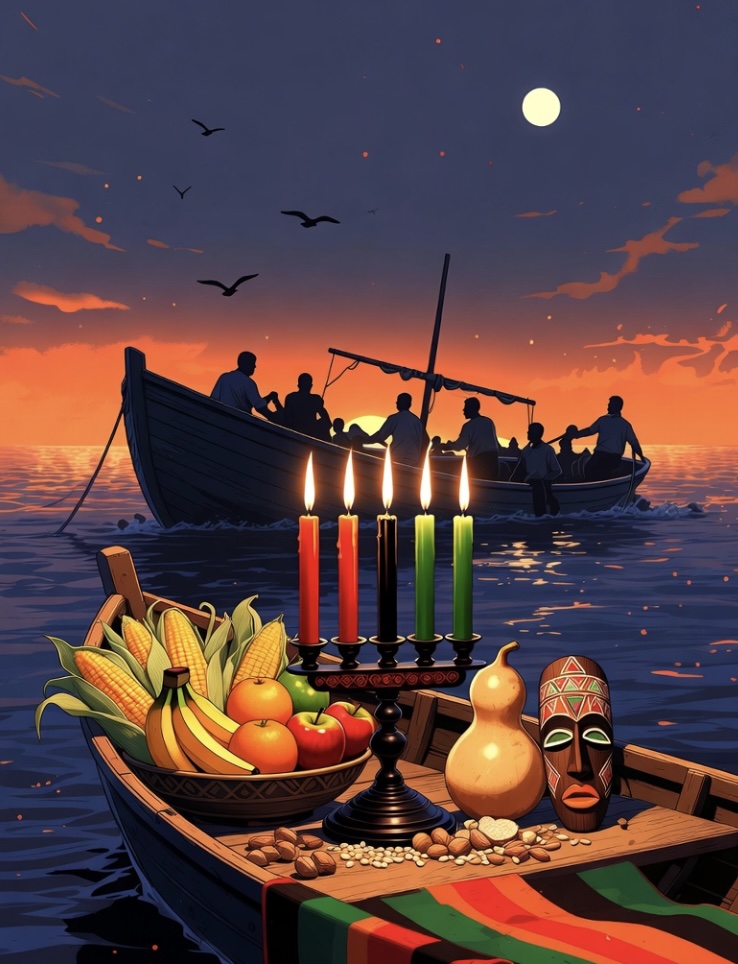
Kwanzaa, the seven-day cultural observance that begins the day after Christmas and runs through Jan. 1, appears to be losing steam as a small, niche tradition. It is not a growing or widely embraced holiday, although a few years ago the media would have had you believe that it was going to be equal to Christmas soon.
Created in 1966 by a radical University of California professor, Maulana Karenga (born Ronald McKinley Everett) during the height of the Black Power movement, Kwanzaa was designed as a secular celebration of African heritage, community, and shared values. It centers on seven principles, such as unity, self-determination, and collective responsibility, and is marked by lighting a kinara, similar to a menorah, candleholder, communal meals, and reflections on cultural identity and identity politics.
While the holiday once enjoyed broader visibility back then, particularly in academic, activist, and cultural institutions, a deep dive into it in 2025 suggests its popularity has not expanded in recent decades. In fact, it may be fading in popularity.
Google Trends data show that searches for “Kwanzaa” still spike every late December, but to a lesser degree as years go by. There is no evidence of a renewed surge in interest in December 2025.
Kwanzaa also did not appear in Google’s 2025 “Year in Search” lists for the final week of the year. The top searches in the United States involved football games.
Survey data tell a similar story. A frequently cited 2019 AP-NORC (University of Chicago) poll found that about 3% of Americans reported celebrating Kwanzaa. That is relevant, since about 14.4% of the US population identifies as black.
Some marketing or advocacy-driven reports suggest higher participation among black Americans, but those claims are not supported by any measurable data.
Last year, the Anchorage Daily News ran an AP explainer about Kwanzaa: “Kwanzaa has become a nationally recognized celebration of African culture and community in the United States since its founding in 1966 and also is celebrated in countries with large African descendant populations.”
This year, the Washington Post ran the exact same story as last year’s AP piece. Media coverage this year reflects the holiday’s current lackluster status.
There has been little reporting on large-scale celebrations or cultural momentum, because it’s just not there to report on. Public acknowledgments from cities, organizations, and elected officials, such as ceremonial greetings or small community events, continue without much public attention. No city is Alaska has made a Kwanzaa proclamation, nor has the governor.
Social media activity during the opening days of Kwanzaa this year has been relatively sparse. Mentions of the observance tend to consist of either informational posts or political commentary or criticism.
In short, Kwanzaa appears to persist much as it has for some time: a niche tradition for a small segment of Americans, but one that has not translated into widespread or growing participation.
9 thoughts on “Is Kwanzaa losing its luster as a cultural celebration?”
Kwanza and other joke holidays like juneteenth.
Unlike Kwanzaa, which was created out of whole cloth by black separatist Ron Karenga in 1966, Juneteenth was based on something that really happened. It is based on the enforcement of the Emancipation Proclamation in the last place in the nation, Jun 19, 1865 by a Union general in Galveston. It was celebrated (or at least remembered) in Texas for over 150 years before Biden ensconced it as a federal holiday. Cheers –
Great. Texas can celebrate it. It is a stupid holiday.
You guys misunderstand me. My only point is that Juneteenth is based on something real (Reconstruction) and has been quietly (and not so quietly) celebrated in Texas for a century and a half. For a long time, it was an excuse to party in the middle of summer before it got too hot. And a lot of people partied.
It wasn’t Texans who elevated it nationally nor demanded it become a national holiday. It was the standard array of race-baiting O’Bama-oids in the Biden regime that did.
OTOH, Kwanzaa came out of the very ugly Left Coast kill whitey black separatist world of the mid 1960s.
What we choose to do with either is up to us as individuals. Cheers –
It still is stupid, no matter what you say.
Anything that’s race based had short runs in popularity
You can’t celebrate Kwanza if you ain’t black person just as Alaskan people shy away from Russian Orthodox when they are not Russian, Aleut, Yupik, or Alutiiq
Losing luster?? It hasn’t had any
Don’t like Kwanza? Don’t celebrate.
Yes it is, just like Easter is.