

THE ALASKA STORY
Nov. 20, 2026 — Four US Army soldiers held a ribbon across a snow-covered road at Soldiers’ Summit in the Yukon on Nov. 20, 1942. It was below zero above Kluane Lake, as Alaska territorial secretary E.L. “Bob” Bartlett and Canadian minister Ian Mackenzie cut the ribbon. Even at those sub-zero temperatures, a band played the two countries’ national anthems. Then, a convoy headed for Fairbanks. The Alaska Highway was open to military traffic.
Two of the men holding the ribbon had helped close the last gap in the road less than a month earlier. On Oct. 25, Cpl. Refines Sims Jr. of the 97th Engineers and Pvt. Alfred Jalufka of the 18th Engineers came upon each other in the spruce near Beaver Creek, close to the Alaska border. They stopped their bulldozers and shook hands. Crews farther south had already joined their sections at Contact Creek in September.
For years, people had talked about building a road to Alaska. Pearl Harbor gave Washington a reason to build it in a hurry. President Franklin D. Roosevelt approved the project in February 1942, and work began in March.
By June of that year, Japanese aircraft had bombed Dutch Harbor and Japanese forces had already occupied Attu and Kiska. The Army needed an overland supply route if ships could no longer reach Alaska safely. The road would also serve the airfields of the Northwest Staging Route, part of the network used to ferry American-built Lend-Lease aircraft to the Soviet Union.
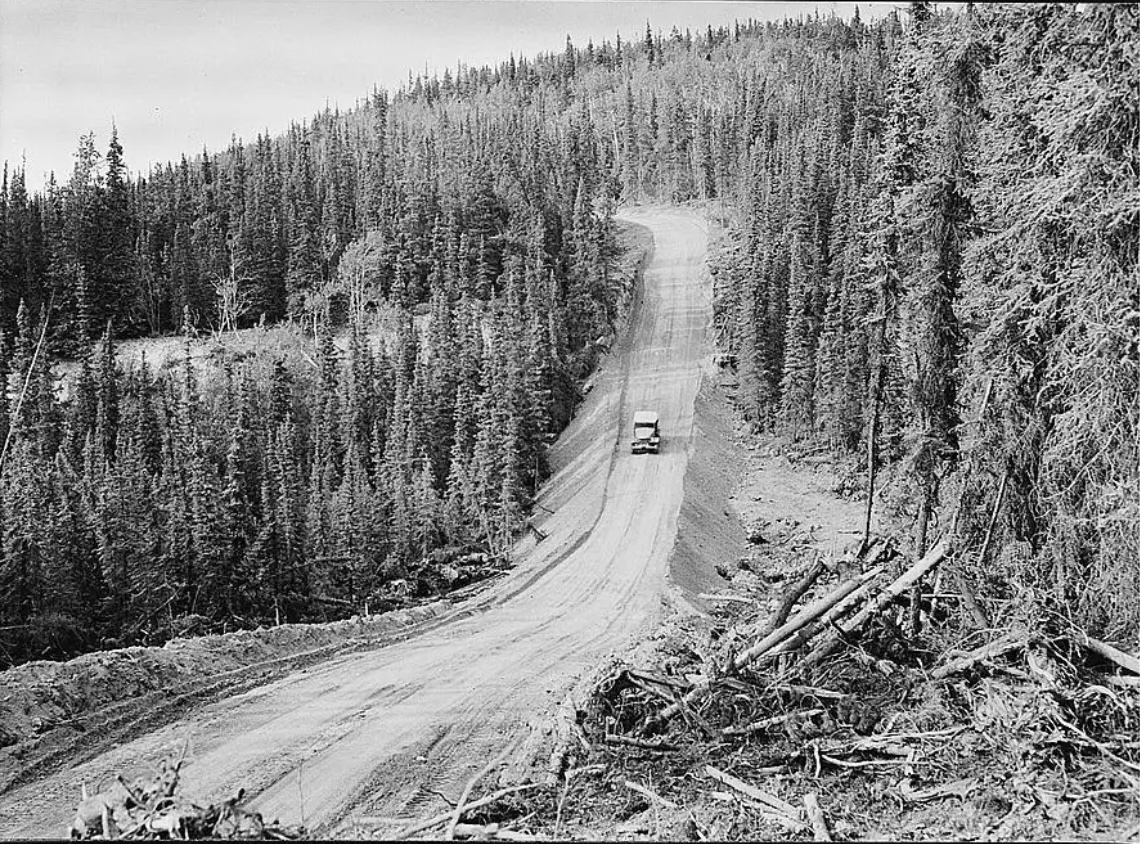
Canada supplied the right-of-way and the United States paid for construction. Army engineers worked from several points at once, drawing on local Indigenous guides and existing trails. Where the ground turned soft, crews laid logs crosswise to make what was known as a corduroy road. They built timber bridges and cut steep grades through country that had never carried truck traffic.
Three of the seven Army engineer regiments assigned to the highway were Black units in the segregated Army. They often worked with second-rate equipment. At Soldiers’ Summit, Sims and Cpl. John T. Reilly, both Black soldiers, held the ribbon alongside Jalufka and Master Sgt. Andrew Doyle.

The pioneer road ran from Dawson Creek, British Columbia, to what is now Delta Junction, where the existing Richardson Highway carried traffic on to Fairbanks. The November dedication marked the opening of a route military trucks could get through. Drivers still had to contend with steep switchbacks, temporary bridges and stretches vulnerable to the thaw. Civilian crews working under the US Public Roads Administration continued to rebuild and improve the route into an all-weather highway.
Canada took control of its section in 1946 and the highway opened to the general public in 1948. Realignments, better bridges and pavement have changed the drive over the decades. At Soldiers’ Summit, visitors can still walk a remnant of the original road above Kluane Lake, where a convoy rolled toward Fairbanks on a cold November day in 1942.