


THE ALASKA STORY
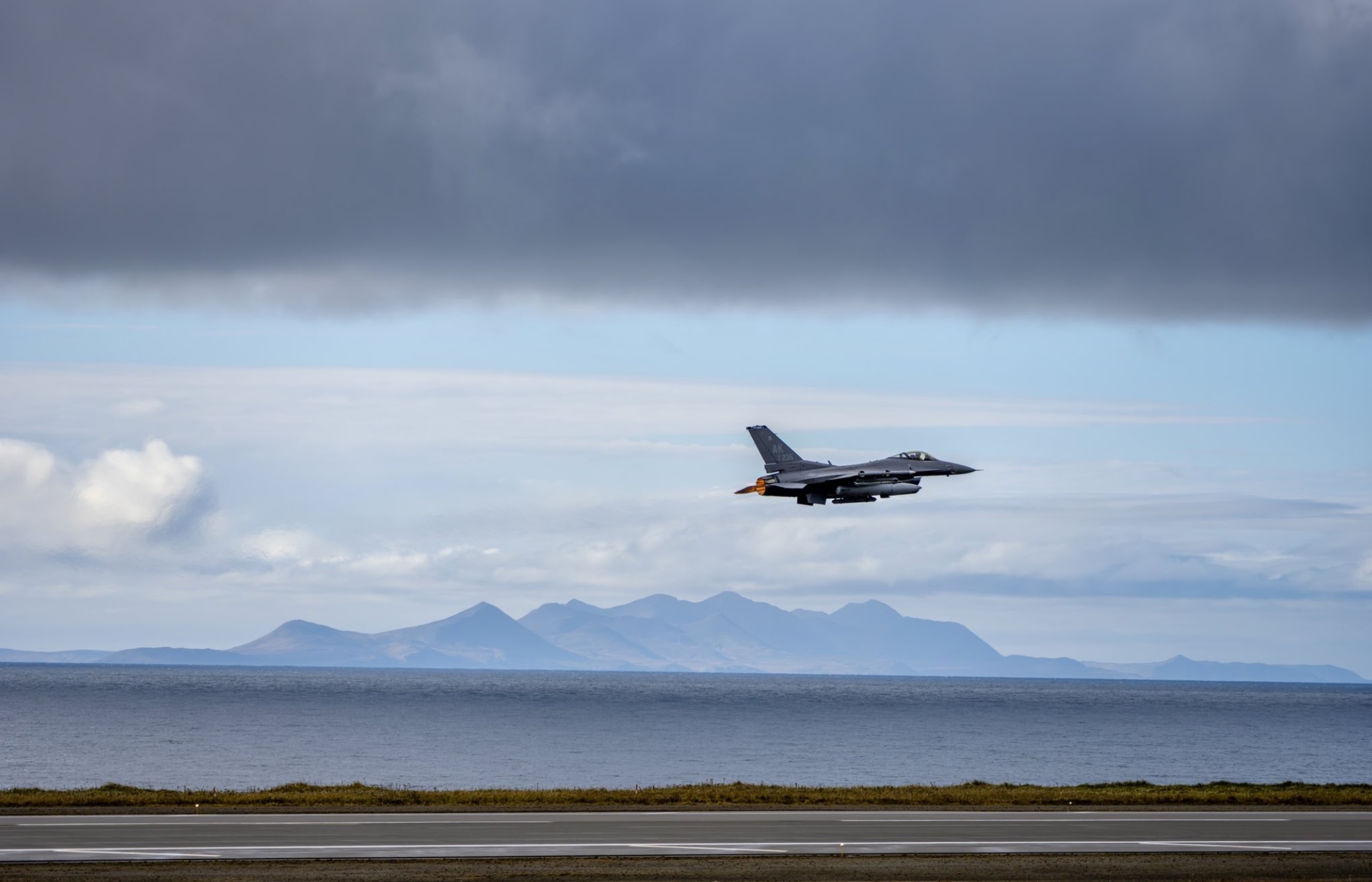
Nov. 3, 2026 – Armed American fighters returned to air defense alert duty on Alaska’s remote Shemya Island in October, reviving a Cold War role for an outpost that puts US air power far west of the state’s principal military bases.
And no, this wasn’t NORAD getting an early start on tracking Santa.
F-16 Fighting Falcons carrying live air-to-air missiles operated from Eareckson Air Station Oct. 18–26. On Oct. 25, they launched into a homeland defense mission involving American and Canadian aircraft operating across thousands of miles.
The deployment marked a return to fighter alert operations at the western Aleutian installation after decades without a routine fighter mission. During the Cold War, F-4s and F-15s deployed to the island to help defend against Soviet aircraft. That regular mission ended in the early 1990s, according to The War Zone.
Fighters have visited Eareckson since then. The distinction this time was their air defense alert assignment: aircraft positioned and ready to launch on short notice.
NORAD said the mission began under Operation Noble Defender before transitioning to Operation Noble Eagle in support of northern sovereignty operations.
Coverage was divided across the Alaska theater. Eareckson’s F-16s covered the southern portion, while F-35s and additional F-16s from Eielson operated in the northwest. Canadian CF-18 Hornets from Cold Lake, Alberta, covered the northern approaches.
Support included an E-3 Sentry from Joint Base Elmendorf-Richardson, American and Canadian aerial refueling tankers, and an HC-130 Combat King II for rescue coverage.
The distances illustrate the challenge: Eareckson is approximately 1,600 miles from Eielson and 2,600 miles from Cold Lake.
“Defending North America demands speed, flexibility, and the ability to bring combat power together across vast distances,” said Lt. Gen. Robert D. Davis, commander of the Alaskan NORAD Region.
The deployment also certified F-16 use of Eareckson’s aircraft arresting system, helping establish the remote airfield’s suitability for future fighter operations.
Shemya’s significance extends beyond its runway. The island hosts the Cobra Dane radar, an important surveillance installation supporting missile warning and tracking. Its location near Russia’s Far East makes it a valuable outpost for monitoring the North Pacific approaches.
Forward-deployed fighters give military planners another location from which to defend those approaches, extending their reach beyond aircraft operating from Alaska’s larger bases.
The October operation was a temporary deployment demonstrating that NORAD can again put armed fighters on alert at an isolated installation whose geography has been strategically important for generations.