


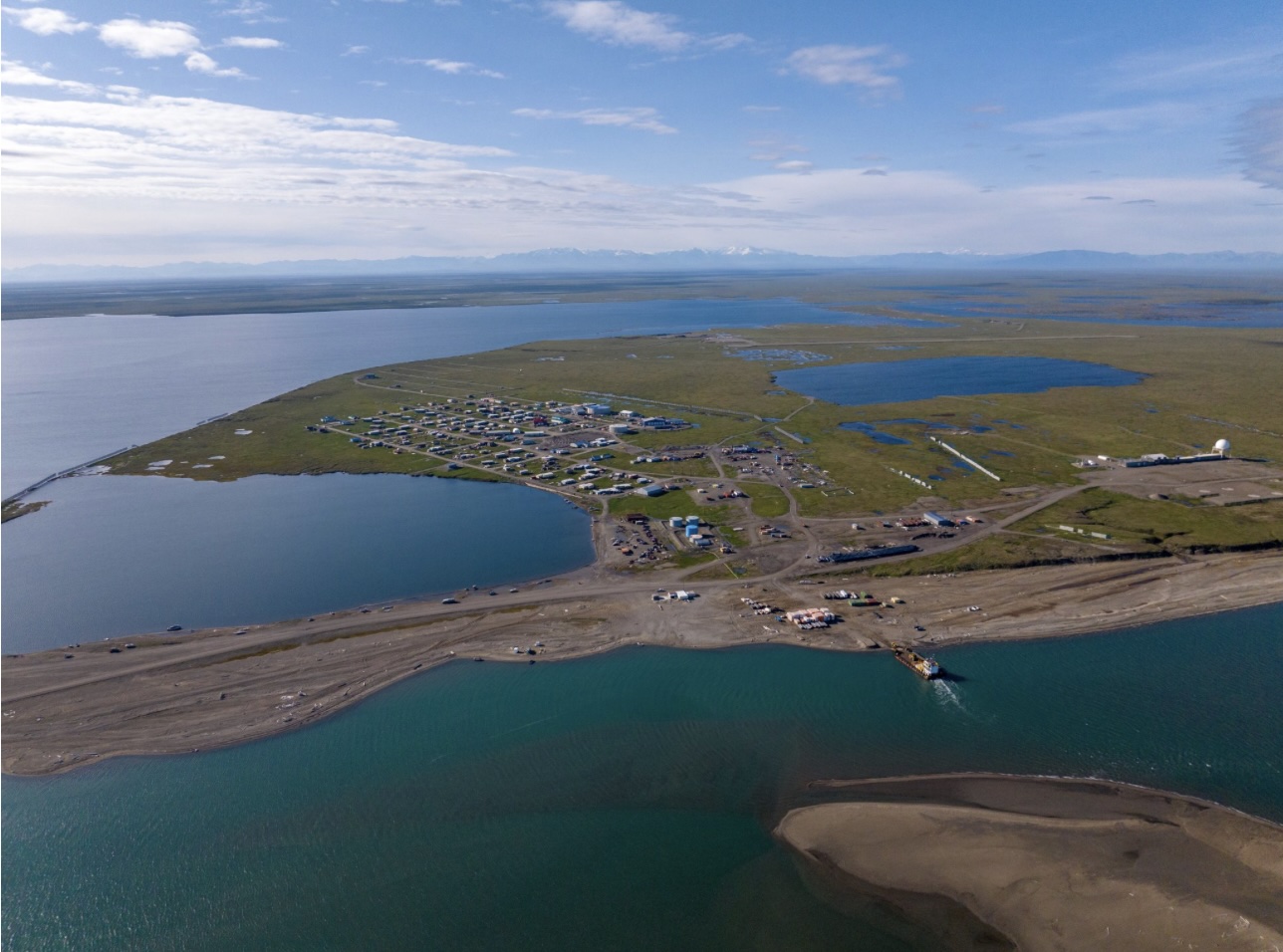
Photo: Aerial shot of Kaktovik.
By SUZANNE DOWNING
Sept. 21, 2026 – The Seattle Times sent environmental reporter Lynda Mapes and a photographer into the Arctic National Wildlife Refuge and came back with precisely the story its Seattle readership might expect from the left-leaning periodical: lyrical descriptions of untouched tundra, vulnerable wildlife and oil development looming over an “American Serengeti.”
What readers did not get was the other half of the story.
Mapes’ account, headlined “Oil interests threaten life in Arctic refuge’s fragile coastal plain,” is written more as an environmental appeal by EarthJustice than a balanced examination of one of Alaska’s longest-running public policy challenge. Caribou glide “like smoke,” she writes. The landscape is an “unsullied wild perfection.” Oil development, meanwhile, is represented by a grim inventory of drill pads, haul roads, man camps, power plants, flares and gravel pits.
It is vivid, purple prose that goes on and on with descriptive flair. It is also selective journalism. Mapes neglected to mention that she used a tank full of fossil fuels to get to the Arctic, and likely required some auxiliary heating source while she was there — and it wasn’t burning seal oil. No doubt her Patagonia jacket, made from fossil fuels, was freshly dry cleaned.
The most conspicuous omission in the report is Kaktovik, the only community located within the refuge.
The Inupiat people who actually live on the coastal plain have long supported responsible oil development. So have the Kaktovik Inupiat Corporation, the Arctic Slope Regional Corporation, and many elected leaders of the North Slope Borough. They see development not simply as an industry proposal, but as a question of economic survival, local control ,and Indigenous self-determination.
The Seattle Times feeds readers the Gwich’in opposition to drilling, centered in communities south of the Brooks Range such as Arctic Village. The paper does not give comparable weight to the Inupiat residents who live closest to the proposed development area and support it. Some Native opinions are more valid than others to the Seattle biased news provider.
The writer also ignored that in 1980 the Native Village of Venetie Tribal Government leased approximately 1.8 million acres of its lands for oil and gas exploration to Rouget Oil Company, reportedly for $1.8 million. Congressional testimony later entered the lease documents into the record. Mapes also ignored that in 1984, after the original arrangement expired, the tribal government again offered essentially the entire 1.8-million-acre landholding for competitive oil and gas leasing.
Mapes is cherry-picking history in the worst way.
The article also says Congress “punted” when it did not designate the 1.5-million-acre coastal plain as wilderness in 1980. That distorts what Congress actually did.
When Congress passed the Alaska National Interest Lands Conservation Act, it deliberately identified the coastal plain as the “1002 area” and ordered studies of its wildlife and petroleum potential so that a later Congress could decide whether to allow development. Most of the refuge was protected from development, while the coastal plain was expressly set aside for further evaluation, with the intent that oil development would occur there.
That was the statutory compromise at the center of ANILCA, not a “punt.”
The Interior Department’s review later recommended that Congress consider leasing the area. Congress eventually authorized an oil and gas program in 2017. Whatever one thinks of that decision, development was not slipped into a place Congress had inadvertently forgotten to protect. Alaskans have fought for it for generations.
The Seattle Times also tells readers what industrial development might bring, but not how limited its actual surface footprint would be. Federal law caps the land occupied by production and support facilities at 2,000 acres — about one-hundredth of 1% of the nearly 20-million-acre refuge. Modern directional drilling, seasonal ice roads and consolidated pads allow operators to reach large underground areas from a comparatively small surface footprint.
The choice is not between untouched wilderness and an industrial complex covering the entire coastal plain, as the article’s imagery encourages readers to imagine.
There is also little meaningful discussion of the decades of experience next door at Prudhoe Bay and Kuparuk. Any development can affect caribou behavior. But in reality, the Central Arctic caribou herd grew dramatically during decades of North Slope oil production before later declining amid broader population cycles.
That undermines the simplistic suggestion that oil infrastructure and healthy caribou populations cannot coexist.
Then there is the article’s curious claim that the Porcupine caribou herd migrates “across approximately 78,000 miles of remote landscape.”
Caribou do not migrate 78,000 miles. The figure appears to confuse the size of the herd’s range with the distance traveled by individual animals. The herd ranges across a vast region of Alaska, Yukon and the Northwest Territories, and its members may travel well over 1,000 miles during their annual movements. But 78,000 miles would amount to circling the Earth more than three times.
The current herd estimate also receives no useful context. The Times puts the population at about 143,000 animals, but does not mention that the herd reached a record estimate of about 218,000 in 2017 and has since declined. Wildlife managers have documented previous cycles, including a decline to approximately 123,000 animals in 2001 followed by years of strong growth.
Herds are influenced by weather, forage, predation, disease, harvest and other natural pressures — not a static population facing only one possible threat.
The polar bear discussion is similarly one-directional. The story cites a decline of “as much as 50%” in the southern Beaufort Sea population and attributes it primarily to shrinking sea ice. The population did suffer a decline, but commonly cited federal research placed that loss at about 40% over the study period, with later estimates generally putting the population at roughly 800 to 900 bears.
The coastal plain is important polar bear denning habitat. But selecting the highest possible decline estimate without explaining the time period, subsequent population estimates or uncertainty turns scientific context into advocacy.
Also absent is why Alaska continues to pursue the area at all. The US Geological Survey estimates that the federal portion of the 1002 area may hold between 4.3 billion and 11.8 billion barrels of technically recoverable oil, with a mean estimate of 7.7 billion barrels. It is a potentially significant national resource and an obvious reason Alaska leaders have supported exploration for decades.
The Times acknowledges that major oil companies have so far stayed away from some leases. The June lease sale drew bids on only five of 58 tracts, covering about 72,000 acres, from the Alaska Industrial Development and Export Authority and the small Alaska company HEX Energy. Weak industry response is largely due to Alaska’s notoriously unstable tax structure, making it impossible to craft good business decisions. The Legislature is not reliable to companies.
That weak industry response also raises an obvious question the article never confronts: If no major company is rushing to build there and no producing project has been proposed, why describe the coastal plain as though bulldozers are already warming their engines?
The Seattle Times published an advocacy hit piece, a carefully constructed narrative that gives extensive space to wilderness advocates while omitting the Inupiat residents who support development, the deliberate history of the 1002 Area designation, the statutory limits on surface development, the experience of neighboring oil fields and the enormous petroleum resource believed to lie beneath the tundra.
The bias is found in whose voices are included, whose are excluded, which facts are emphasized and which ones never make it into the story.
The full article is here, and conveniently was not behind the Seattle Times paywall this weekend. It’s another technique that newspapers use to push a narrative — which articles they charge for and which they do not put behind the paywall.
One thought on “Seattle Times report cries tears for Alaska’s far north — but misses the reality of Alaskans who live there”
They blather on with their ridiculous “land acknowledgements”, then proceed to preach to the natives about what they are allowed to do with their land. There is nothing about leftists that isn’t phony.