A new national study finds that the number of young Americans identifying as transgender or non-binary has dropped sharply since 2023, signaling what researchers describe as the first sustained decline in trans and queer identification among Generation Z.
According to the Centre for Heterodox Social Science, 3.6% of US undergraduate students in 2025 identified as something other than male or female – down from 6.8% in 2023.
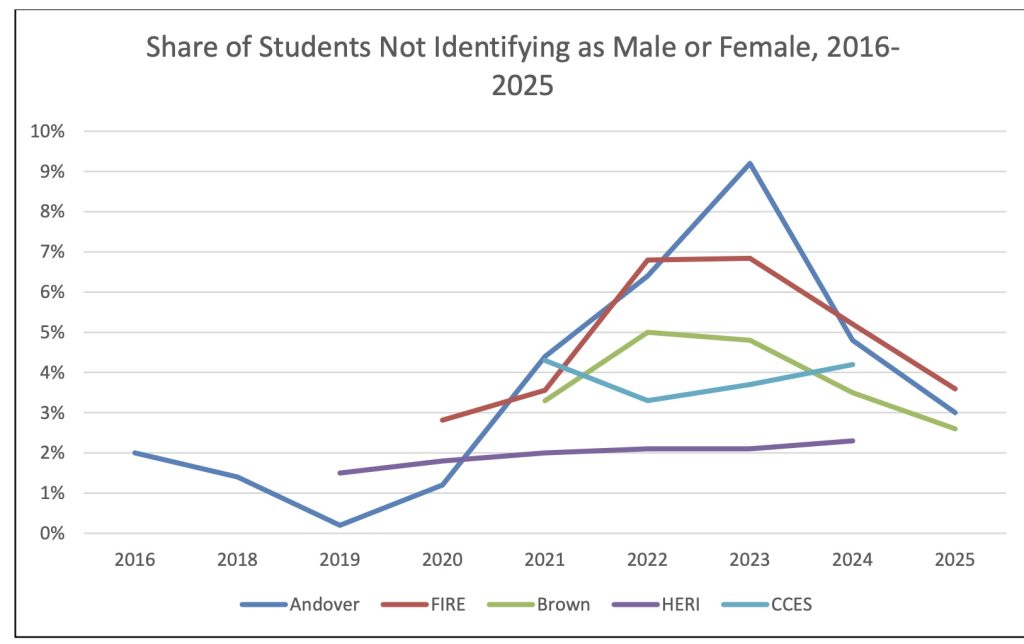
That represents a nearly 50 percent decrease in just two years. The study draws on a range of major youth survey sources, including annual campus surveys by the Foundation for Individual Rights and Expression, which sample more than 50,000 students each year, and the Higher Education Research Institute’s freshman survey.
The research also incorporated data from the Centers for Disease Control and Prevention’s Youth Risk Behavior Surveillance System, as well as polls conducted by Brown University and Andover Phillips Academy, both of which showed similar trends.
Read the study for yourself at this link.
Across multiple data sets, the share of young people identifying as non-binary or questioning their gender fell markedly after peaking in 2022–23. Among Ivy League students, the proportion identifying as something other than male or female rose from 3% in 2021 to 7% in 2023 before returning to 3% in 2025.
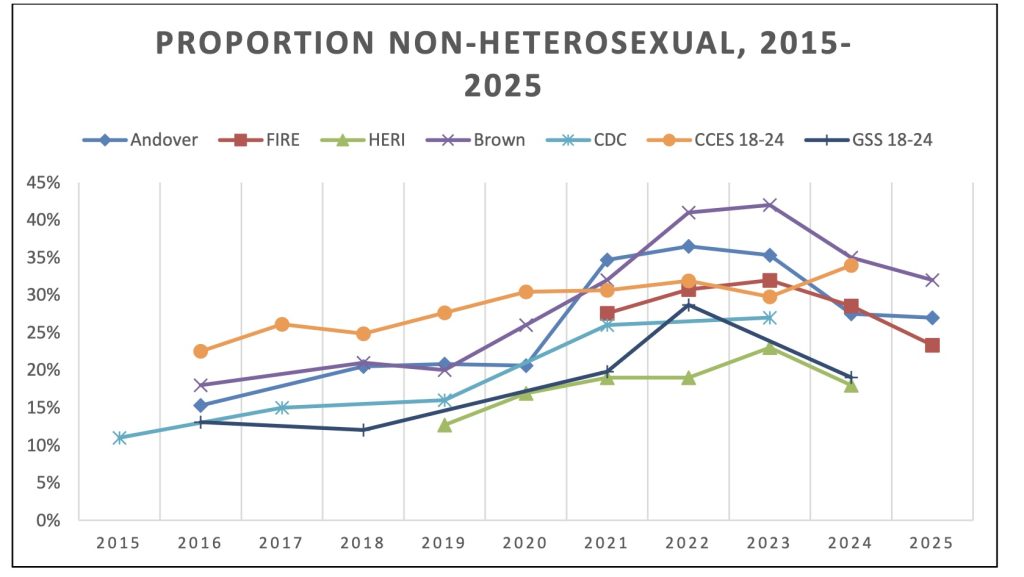
The same pattern appears in sexual orientation data. The percentage of students identifying as non-heterosexual, including those identifying as bisexual, queer, or pansexual, surged through the early 2020s but has since declined. FIRE survey data show heterosexual identification dropped from over 80% in 2020 to 68% in 2023, before rebounding to 77% in 2025.
While the share of students identifying as gay or lesbian has remained stable, the number identifying as bisexual or “queer/other” has fallen significantly. At Brown University, for example, bisexual identification peaked at around 18–19% of students in 2022–23, but dropped to 13% in 2025.
The findings suggest that trans and queer identities, which surged among young Americans in the 2010s and early 2020s, may now be declining in popularity, especially in elite academic settings. The trend also appears generational: Today’s freshmen are less likely than seniors to identify as transgender, bisexual, or queer, indicating that younger cohorts are entering college with lower rates of nontraditional gender or sexual identities.
The study notes that the decline does not appear to be tied to changes in social media use, political leanings, or religious belief. Instead, there is limited evidence that improved mental health among youth may be contributing to a reduction in LGBTQ+ identification, though researchers emphasize that the causal relationship remains unclear.
Overall, the data point to what the Centre for Heterodox Social Science calls a “rise and fall” pattern — with trans, bisexual, and queer identities reaching a high point around 2022–23 before receding toward pre-surge levels. What comes into fashion ultimately goes out of fashion.