


By SUZANNE DOWNING
Sept. 8, 2026 – A computer simulation of a hypothetical Alaska governor’s race shows how three Republicans splitting the vote against one Democrat could produce sharply different outcomes, depending on voters’ willingness to rank additional candidates.
The simulation, conducted with Google’s Gemini artificial intelligence model, demonstrates how particular assumptions about voter behavior — including “ballot exhaustion” and crossover voting — can affect the ranked-choice tabulation.
To keep the exercise focused on the mathematics rather than the personalities, the four candidates in our simulation are identified as Candidates A, B, C, and D.
Alaska’s general elections are conducted through ranked-choice voting, and have been since 2022. Since then, only three races have ever been actually decided through ranking. It’s poorly understood and difficult to explain, due to the variable of human nature.
The way ranked-choice voting works is that if no candidate receives a majority in the first round, the candidate with the fewest votes is eliminated. Ballots assigned to that candidate move to the next-ranked candidate who remains in the race. Thus if your first choice was Candidate C, and Candidate C was eliminated, your ballot would go to your next choice, such as Candidate B, The process continues until two candidates remain, with the candidate receiving the most active votes declared the winner. The most votes is 50+1.
Voters are not required to rank every candidate. They may rank one candidate or several. A second choice is counted only after the voter’s first choice has been eliminated, according to the Alaska Division of Elections.
Thus was born the phrase, “ranking is for losers.” Ranking only matters for your ballot if you did not choose the most chosen candidate first.
A ballot becomes exhausted (or inactive for purposes of later rounds) when it no longer contains a valid ranking for a candidate who remains in the contest. That can happen because the voter ranked only one candidate, or two candidates.
The first simulation we ran began with 300,000 votes.
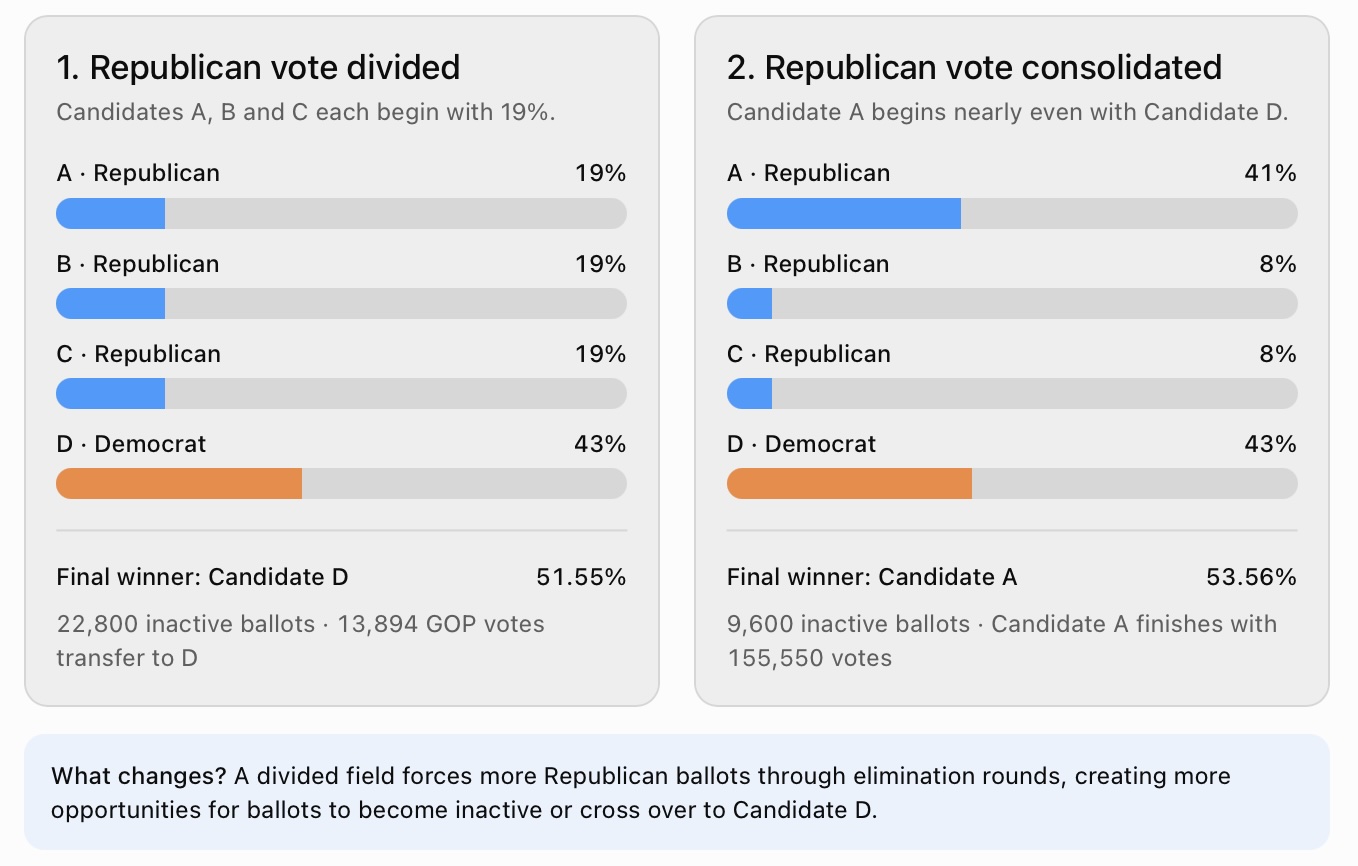
Candidate D received 43%, or 129,000 votes. The three Republicans divided the remaining 57% evenly, giving Candidates A, B and C 57,000 votes apiece, or 19% each.
The model assumed that when a Republican candidate was eliminated, 20% of that candidate’s original supporters did not rank another active candidate. Another 10% transferred to Candidate D, while the remaining 70% moved to one of the remaining Republicans.
Of Candidate C’s 57,000 votes, the simulation sent 19,950 to Candidate A, 19,950 to Candidate B and 5,700 to Candidate D. The remaining 11,400 ballots became inactive. That may be an underestimate of how people actually vote and choose not to rank. A20% ballot exhaustion rate is a historically conservative estimate.
After those transfers, Candidate D had 134,700 votes. Candidates A and B each had 76,950. The active vote pool fell from 300,000 to 288,600.
The model then eliminated Candidate B. After transferring the eligible ballots, Candidate A finished with 134,306 votes, while Candidate D finished with 142,894.
Candidate D therefore won the hypothetical contest with 51.55% of the 277,200 active votes remaining in the final round. Candidate A had 48.45%.
A total of 22,800 ballots became inactive by the end of our simulation. Candidate D also received 13,894 votes transferred from voters who initially supported Republican candidates.
The second simulation used the same 300,000-voter electorate and the same transfer assumptions, but it began with Republican support much more heavily concentrated behind Candidate A.
Candidate D again started with 43%, or 129,000 votes. Candidate A received 41%, or 123,000 votes. Candidates B and C received 8% each, or 24,000 votes apiece.
Candidate C was eliminated first. Its votes moved according to the same assumed pattern: 8,400 went to Candidate A, 8,400 went to Candidate B, 2,400 went to Candidate D and 4,800 became inactive.
That left Candidates A and D tied at 131,400 votes, while Candidate B had 32,400.
When Candidate B was eliminated, Candidate A received an additional 24,150 votes under the model. Candidate D received 3,450 more.
Candidate A won the simulated final round with 155,550 votes, or 53.56% of the remaining active vote. Candidate D finished with 134,850, or 46.44%. Only 9,600 ballots became inactive before the final result.
The two scenarios illustrate the mathematical advantage of entering the ranked-choice count with a large first-choice base. In the divided scenario, where Republicans are not consolidated behind one candidate, Republican voters must pass through more elimination rounds, creating more opportunities for ballots to exhaust, mistakes, or transfer to Candidate D. In the consolidated scenario, Candidate A began close enough to Candidate D to benefit quickly from the elimination of the two smaller Republicans.
The exercise also illustrates the political dispute surrounding the phrase “rank the red.”
Some Republican organizers use the slogan to encourage voters to rank every Republican on the ballot, even when their preferred candidate is eliminated. Mathematically, doing so reduces the number of Republican ballots that become inactive before the final round.
But ranking additional candidates remains optional. Some voters may determine that another candidate carrying the same party label does not share their values sufficiently to earn a second or third ranking. In the old days, it was “vote your values.” Now, some have morphed that into, “rank whoever has a R behind their name.”
But campaign appeals, party pressure or slogans cannot guarantee that conservative voters will transfer their support to candidates they do not favor or who do not reflect their beliefs. In House District 23, Ruby Jones just registered as a Republican and filed to challenge Rep. Jamie Allard. Both have Rs behind their names but no one would confuse “Decoy Jones” for an actual conservative.
The Division of Elections says voters may rank “as many or as few candidates as you would like.” Ranking another candidate does not weaken a voter’s first choice, because the later ranking is not considered unless the earlier choice has been eliminated. If you vote for the winner, your ballot is done.
The simulation is based on certain assumptions. Its 43% starting share for Candidate D, its 20% Republican exhaustion rate and its 10% Republican crossover rate are one set of assumptions. Different starting percentages or transfer patterns would produce different results.
This simulation also simplifies the order in which transferred ballots move after multiple eliminations. A real tabulation follows every voter’s individual rankings rather than applying one uniform transfer formula to an entire group. This is one reason ranked-choice voting is so difficult to explain to people. Each ballot is its own universe. And each round of counting is like its own election.
The model demonstrates a structural challenge and a cognitive challenge in ranked-choice voting for the three Republicans now running for governor.
Under ranked-choice voting, first-choice totals matter, but they are only the beginning. Whether voters rank additional candidates, and whom they are willing to rank, may determine how many ballots remain active when the race reaches its final two candidates.
‘Rank the red’ is a slogan, but not a strategy. Alaska’s election history proves it



23 thoughts on “The Alaska Story investigation: How ‘ranking the red’ really works when the Republicans don’t consolidate”
McCabe makes a little more sense regarding Rank the Red over on The Watchman.
And I’m not a fan of McCabe.
Also not a fan. But McCabe does make some very good points in that article.
This is NOT complicated. Just think of RCV as instant runoffs, until someone gets 50%. Think how you would vote if your candidate comes in fourth and rank the others as you like. Good grief but I can’t believe how confused people still are after years of this.
Democrats won’t rank. They will vote ONLY for JKT, thereby nullifying any distribution whatsoever of other candidates. “Rank only the primary Blue” is the Democrats slogan. Meanwhile Republicans are still stuck in their August primary election. Not a winning strategy.
By ranking the red, neither Bronson or JKT get 50% of the vote triggering a runoff of which Bronson picks up voters of the other two disqualified republicans. Real simple.
Thank You. Ms Downing. For spelling out how Ranking the Red or even the blue is really chance not a strategy.
The AkGOP leaders think they are being smart by when they had 13 Republicans before the primary and currently three in the top four.
They will be shocked, confused, and disappointed when they lose in November, but I think your GOP leaders are too ignorant and illiterate they won’t put one n one together to understand why they lost. I’ll spell it out. Future elections Republicans MUST be Unified behind one candidate despite your grievances about them and their shortcomings. Guess what repealing RCV will again be narrowly defeated again. So that means Republicans MUST make themselves be unified.
We must get rid of skank choice voting. Besides outright cheating (think Decoy Dan), it’s the easiest ways for the Demoncats to win elections. They are pretty good at scheming and cheating, and outright lying. Eliminating RCV will take away one of their primary tools for rigging the elections and getting these dirty little commies elected.
JB. As much as we want to see RCV repealed. Be prepared it’ll most likely be narrowly defeated again.
That means Republican voters must learn to vote in lock step and unity despite personal grievances about a candidate or their shortcomings.
Right now by how most Alaskans think. Getting rid of RCV is a fantasy or a dream because over 50%of likely Alaskan voters are illiterate. The only way to start solving that illiteracy problem is if Republican families Disenroll their children out of the public school district and send them into a private school or homeschool. Even that’s a fantasy or wishful thinking that parents who are just as illiterate as their child for them to think ahead about the future and change their child’s education direction by changing school types.
Another reminder for AKGOP to get the message out. Do not rank JKT as a fourth choice else he’ll get your vote.
So in short, every conservative should strongly consider ranking the front-runner Wilson 1st. If they can’t handle that, absolutely rank all 3 Republicans. We win. Yes on 2 to end this mess.
And, stop crying over spilled milk.
Please.
What the Democrats fear most is Republican unification behind one Republican candidate. The Democrats cannot defeat that scenario, and they know it.
I think that if scenario 2 gives the Democrat the Governor’s House, and Alaskans learn that Republicans garnered over 50 percent of the vote we could see another kind of vote take place afterward.
The glories of RCV.
Please vote to do away with this.
Thanks. All very interesting. Except it’s not USA voting. So why did Alaska go with RCV? I know, rhetorical question.
According to Wiki, Hawaii, Maine and DC use RCV……I don’t think we could go wrong doing the exact opposite of Hawaii, Maine and DC.
By looking at the published models put forth by Alaska Story and looking at the 2022 election results where Palin and Begich ran against each other, it makes the most sense to rank the #1 R vote getter, which is Wilson/ Showers FIRST. The most votes in the first round against JKT , the better outcome, Then rank the other two R’s accordingly –preferably by order of votes cast in the primary. We must rank all. We want R’s to get every single red vote.
So far the most sensible comment I’ve seen.
I’ll hang on the polls for a while, but I agree, this makes sense.
In honor of Suzanne downsydrone and Amy damitalboski I am going to rank the penis cookies, so that the pedophile prick stays in his underpants!
Thanks, Dave, for warning us about JKT.
We probably don’t know as much about his sexual preferences as maybe you do, but we’ll take your word. How do you know JKT even wears underpants?
Yours is the most juvenile and demeaning (and ONLY) comment of its nature on the article. Way to show your true colors, Dave
Proud of yourself?
Your analysis is flawed, because you are comparing apples and oranges. In your second case you are shifting both first choices *and* second choices to the Republican front runner, so it’s not at all surprising that they end up winning, and doesn’t in the least delegitimize the first case. If you only shift first-choice counts but leave the second choice counts alone, rather than maintaining the same percentage of second-choice rankings, then the Democrat still wins.
[…] The Alaska Story investigation: How ‘ranking the red’ really works when the Republicans … […]