


By SUZANNE DOWNING
Aug. 24, 2026 – Alaska’s newest major oil field averaged approximately 22,537 barrels per day in July as Santos continued bringing wells online at its Pikka Phase 1 development on the North Slope.
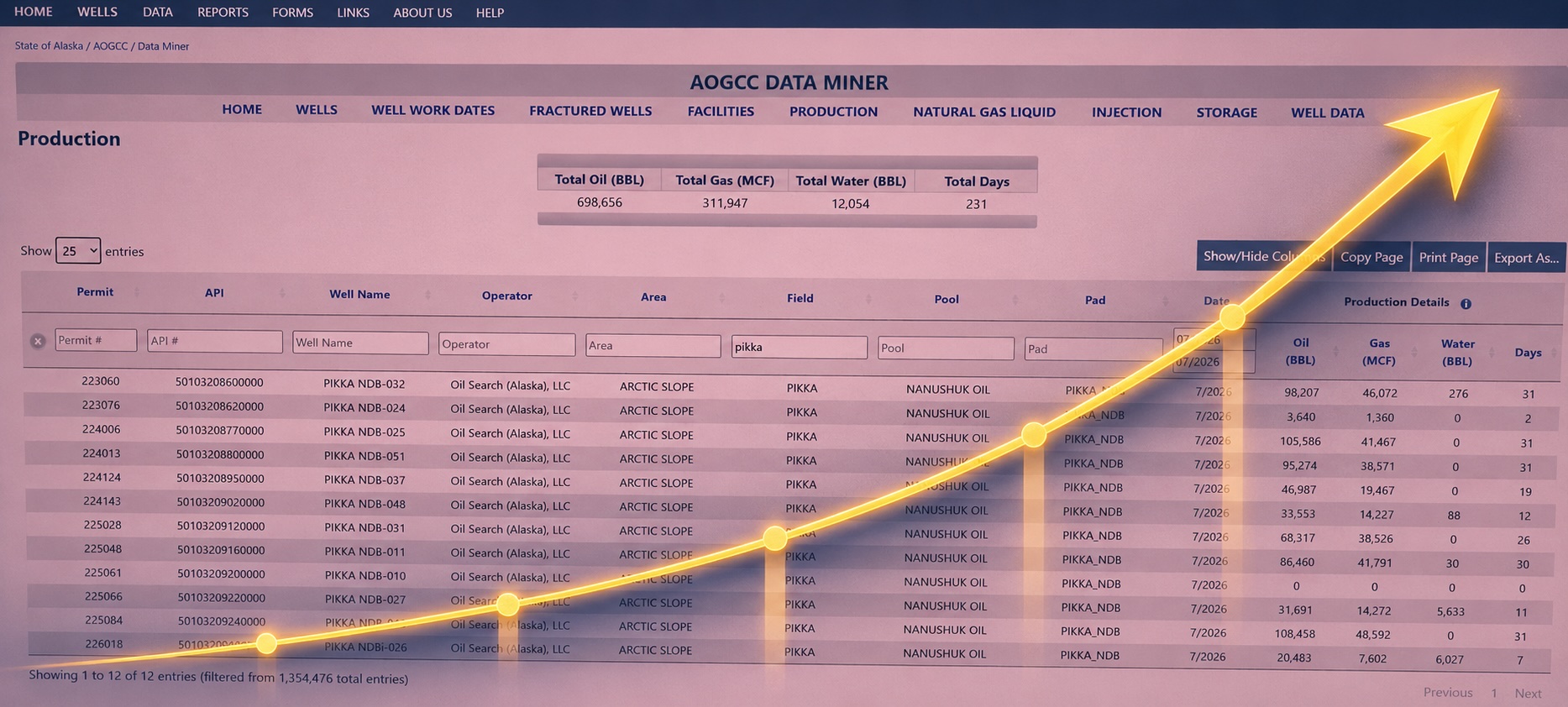
The July figure is based on official Alaska Oil and Gas Conservation Commission production data showing that Pikka produced 698,656 barrels during the 31-day month.
Twelve Pikka production wells appear in the AOGCC Data Miner report for July. One showed no production during the month, while only four were listed as producing on all 31 days. The remaining wells operated for periods ranging from two to 30 days.
AOGCC counts a producing day when a well flows for any portion of that day, even if it operates for only an hour. That means the monthly figures do not represent the field’s full production capacity, particularly while Santos is progressively starting wells and commissioning the project’s supporting systems.
With seven of the producing wells online for fewer than 31 days, August production could rise substantially if those wells operate closer to a full month. Additional production from newly activated wells could also more than offset normal declines from wells that were already flowing.
Pikka’s cumulative oil production reached 972,241 barrels through the end of July, according to the state data.
The project achieved first oil on May 17, several weeks before Santos announced the beginning of continuous production operations in late June. At that time, the first wells were delivering approximately 20,000 barrels per day.
Santos said it would progressively bring more wells online and begin seawater injection to support reservoir pressure, with the field expected to reach a plateau of approximately 80,000 barrels per day during the third quarter of 2026. The company reported in August that Pikka was producing approximately 23,000 barrels per day, consistent with the continued ramp-up shown in the state’s July figures.
Pikka Phase 1 is operated by Australia-based Santos, which owns a 51% interest in the development. Spanish energy company Repsol owns the remaining 49%.
The development is targeting the oil-rich Nanushuk formation west of the established Kuparuk River oil field. Santos entered Alaska through its 2021 acquisition of Oil Search, which had purchased interests in the Pikka development from Armstrong Oil & Gas and other owners.
Santos and Repsol approved the $2.6 billion first phase in 2022. The project includes a drill site, oil processing facilities, pipelines and seawater-treatment infrastructure. Phase 1 brings approximately 400 million barrels of gross proven and probable reserves into production, with an additional estimated 600 million barrels of resources that could support later development.
At its targeted plateau, Pikka would add approximately 80,000 barrels per day to the Trans Alaska Pipeline System and rank behind only Prudhoe Bay among Alaska’s producing fields. The new production is expected to help counter the long decline in North Slope output while generating new state royalties and production-tax revenue.
Pikka also reached another milestone this month when Santos and Repsol loaded the first cargo of Pikka crude at the Valdez Marine Terminal. The partners are expected to alternate tanker shipments from Valdez.
The July report offers the clearest official look yet at how quickly Alaska’s newest producing field is building momentum. With most of its active wells still operating for only part of the month, Pikka has considerably more production waiting to come online.



One thought on “Pikka oil production tops 22,500 barrels per day in July as North Slope field ramps up”
Why does the Dept. of Revenue not show the Pitkka production on their web site with all the other fields.