


By SUZANNE DOWNING
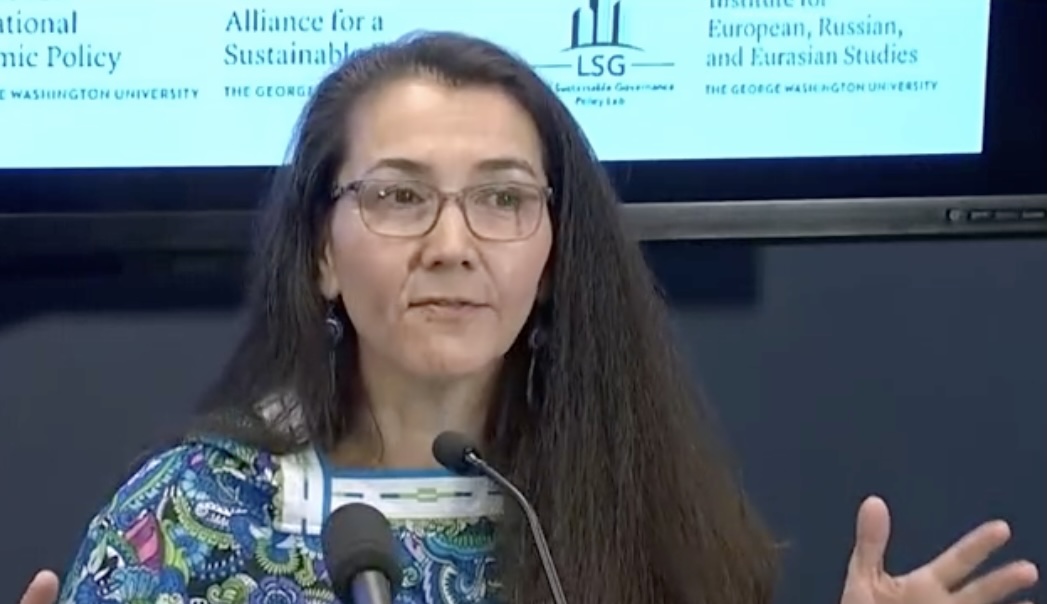
Aug. 21, 2026 – Democrat US Senate candidate Mary Peltola is turning taxpayer funding for public broadcasting into a campaign issue, accusing Republican Sen. Dan Sullivan of “abandoning Alaska” by supporting cuts approved by Congress last year.
“Public radio is life and death in Alaska,” Peltola said in an Aug. 21 video and related social media posts. “It’s how we know if it’s safe to hunt or fish, how we navigate deadly weather, and how communities receive lifesaving emergency alerts. Dan Sullivan clawing back the funding our stations rely on isn’t leadership. It’s abandoning Alaska.”
Public radio remains popular in Alaska, particularly in rural communities, and local stations provide news, entertainment, cultural programming, and community announcements. But Peltola’s assertion that it is a matter of “life and death” treats Alaska’s communications system as though little has changed since the days when a battery-powered radio was often a village’s principal connection to the outside world.
Starlink and other satellite providers have over 12,000 satellites serving Alaska, The constellation provides widespread coverage across Alaska, including remote and northern areas), with ongoing launches into polar orbits specifically to boost capacity and speeds for high-latitude users.
In short, the technology has changed dramatically since public broadcasting started in Alaska in the last century. Most Alaskans now carry mobile phones capable of receiving emergency notifications directly from federal, state and local authorities. Wireless Emergency Alerts can be transmitted automatically to compatible phones in a targeted geographic area without requiring users to subscribe, download an application or listen to a particular station.
Those alerts are part of the federal Integrated Public Alert and Warning System, which distributes warnings through multiple channels—not only radio and television, but also mobile phones and other communications networks. Alaska has tested emergency messages simultaneously through the broadcast Emergency Alert System and the mobile Wireless Emergency Alert system.
Weather forecasts, marine warnings and severe-weather advisories are available directly from the National Weather Service through phones, websites, applications, marine radios and satellite communications. Hunting and fishing regulations are published by the Alaska Department of Fish and Game and can be accessed online, downloaded in advance or obtained in printed form.
But being useful, interesting, or entertaining is different than being the sole barrier between life and death.
Alaskans traveling beyond cellular coverage have long relied on VHF radios, satellite phones, personal locator beacons, emergency beacons and, increasingly, satellite messaging through ordinary smartphones. Hunters, fishermen and mariners are not supposed to depend on hearing a public-radio broadcast as their only safety plan.
Peltola’s argument also blurs the distinction between public broadcasting and emergency communications. Government agencies can issue emergency alerts whether or not a community’s radio programming is produced by an NPR affiliate. Congress could also support rural warning infrastructure or tribal communications directly without financing the entire national public-broadcasting structure and its news and entertainment programming.
Congress voted in July 2025 to rescind $1.1 billion previously approved for the Corporation for Public Broadcasting. Sullivan supported the rescission package, while Sen. Lisa Murkowski opposed it and unsuccessfully offered amendments intended to preserve funding for rural stations.
Sullivan has also supported a separate funding stream for tribal public-radio stations and has continued working to include money for that program in the Interior Department budget. That detail was absent from Peltola’s accusation.
The debate ultimately is not whether Alaskans enjoy or appreciate public broadcasting. Clearly, many do. The question is whether taxpayers must continue financing it—and whether a vote to reduce that subsidy can honestly be characterized as abandoning the state.
By declaring public radio itself to be “life and death,” Peltola appears to be taking a popular source of news and entertainment and elevating it into an indispensable public-safety service. That is so last century.



10 thoughts on “Peltola calls public radio ‘life and death’ in Alaska, but technology has changed since the last century”
It is life and death in Alaska. This is Free over the air propaganda for the left. Of course they want this paid for by the taxpayers. Republicans are just stupid for allowing this money to be spent.
Mary should have said that Public Broadcasting is a reliable source of leftist agitprop and she can’t get elected without it. That would be somewhat more honest.
If you enjoy programs about the difference between African and European swallows, by all means more power to you. AK Public Media will gladly take your donation. They are not picky and take anything from cash to cars, crypto to estate giving or you can buy some merch or membership to support them.
Do NOT however expect the taxpayers to pay for your private need for knowledge in coconut carrying swallow classification……
The bias toward the Democrat’s agenda, what the media calls progressivity, and woke-ness is continual and palpable. They don’t let up for a moment. The week-night PBS news is so Afro-centric that every report on every topic carries an anti-white and anti-Asian agenda. Recently the program is also anti-Semitic. We are so fortunate to now have elected officials who have removed taxpayer support of these terrible people. Let’s make sure we all vote!
Public radio is nothing but Marxist propoganda. Brainwashing. Whining because not enough public money is being spent on the poor Natives out in the Bush who are getting their quarterly corporation dividends because they are Native blood. Calling in on the satellite phone: “khoney, the caribou took a different route today, so call the fast food joint in the village and order pizza, delivered. Hold the anchovies, I’m drinking beer tonight. I’ll be at home in 30 minutes after I get the side by side gassed up and loaded on our new GMC Denali HD.”
Satellite phones. High speed Internet. Cellphones. Lap tops. 24/7 porn on demand. The Villages are fully wired on public money and running full speed. As usual, Mary Peltola is full of sh*t.
Kemosabee is a truth speaker. Village Natives may still poop in honey buckets when the lights go out, but don’t blame the diesel and gasoline distributers. Plenty of fuel to run all of those new snowmobiles, four-wheelers, and $30K outboards. Money is not the problem. Mary Peltola is the problem.
I used to donate to my local public radio station for decades, but they lost me when they started to air the BBC and other foreign propaganda outlets. Also, their long list of multinational corporate sponsors convinced me that they really didn’t need my measly $120 contribution. NPR aka National Propaganda Radio!
Those few of us who watched congressional hearings about NPR saw the factual data which we already knew. Their employees were 95% democrat, and their hard left angle of “reporting ” is 90%+ anti republican. I’ve lived in areas of our state with public radio the dominant station. Their consistent spewing of one sided political verbal vomit was effective because it had no counter point. Clever and crafty propaganda aimed at non-thinkers telling them how smart they are to lick it up.
It is utter useless rhetoric to read that public radio be “life or death”. I live alone, rural Alaskan and self-sufficient and NEVER listen to APR or NPR and do not intend to expose myself to the pablum they produce.